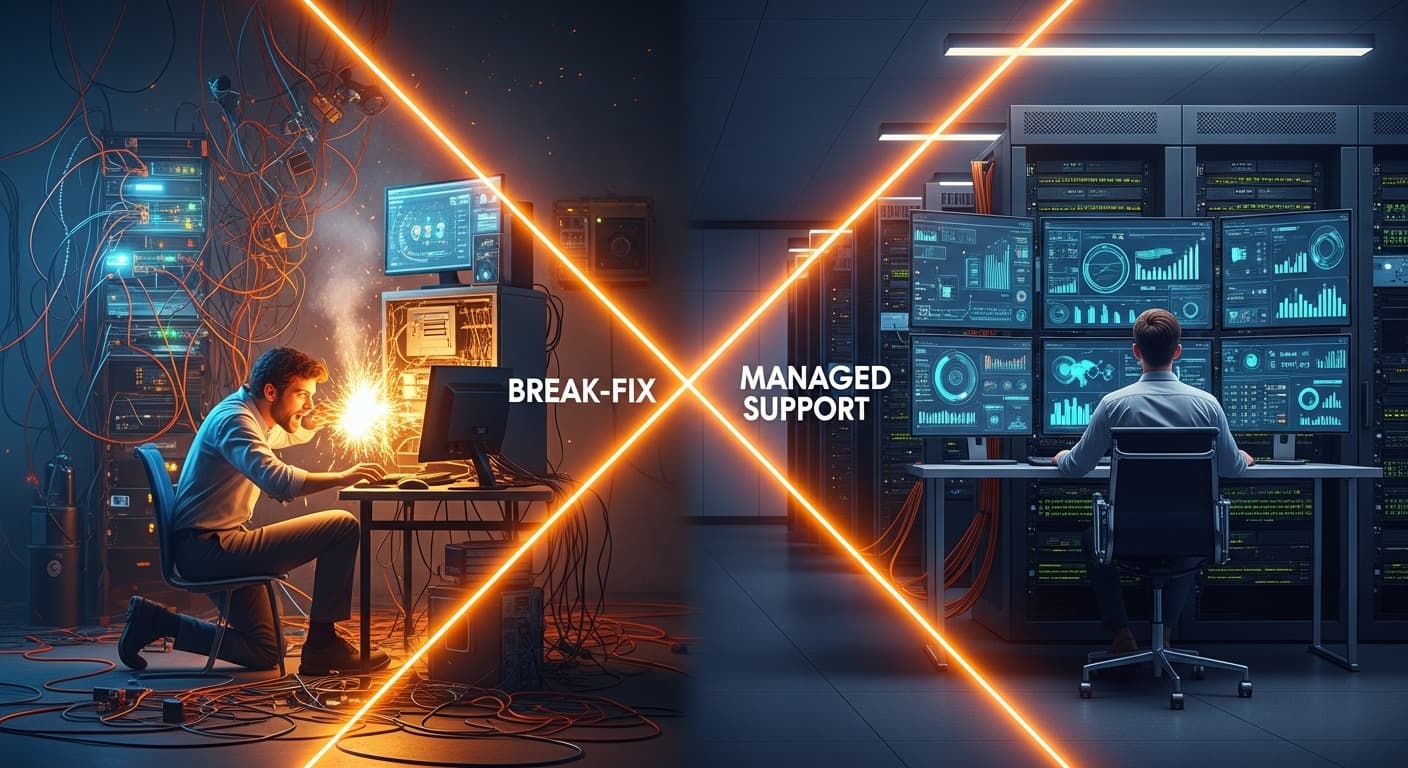

For many UK SMEs, the "break-fix" IT model feels like a comfortable default. You run your systems until they stutter, you call a technician, they fix the immediate problem, you pay the invoice, and you carry on. This approach gives the illusion of cost-effectiveness because payment occurs only when something demonstrably breaks. However, this reactive stance is a silent tax on your productivity, your security posture, and your long-term operational stability. In an environment where even a single hour of downtime can cost a small business thousands in lost revenue and reputational damage, relying on a "hope for the best" strategy is no longer a sustainable business plan. Transitioning to a Managed Service Provider (MSP) model isn’t just about upgrading your IT support; it is about shifting your technology from a source of constant frustration into a strategic engine that genuinely drives your business forward.
What transition from reactive break-fix IT to managed support actually means
To be clear, 'break-fix' IT is exactly what it sounds like. Something breaks, you call someone, they fix it, and you pay for that specific repair. It's a transactional relationship, akin to calling a plumber only when a pipe bursts. Managed IT support, on the other hand, is a proactive partnership. Instead of waiting for failure, an MSP actively monitors, maintains, and secures your IT infrastructure to prevent issues from arising in the first place. This means regular updates, constant security surveillance, and strategic planning for your systems' longevity. Essentially, it's moving from emergency repairs to preventative care, ensuring your technology functions reliably as an integrated part of your business operations rather than an unpredictable cost centre.
Why it matters for UK SMEs
The primary misconception about break-fix support is that it saves money. While it avoids a monthly retainer, it masks the true cost of IT mismanagement. When you wait for a system to fail before addressing it, you are effectively paying for 'emergency room' service. Emergency repairs are significantly more expensive than preventative maintenance, and they inevitably happen at the worst possible time.
Beyond the immediate invoice, consider the 'hidden' costs:
- Productivity Erosion: Every minute your staff spends troubleshooting a printer, waiting for a slow system, or dealing with a failed login is a minute they aren't generating revenue. This isn't just about lost work; it's about frustrated employees and missed opportunities.
- Security Vulnerabilities: Break-fix providers rarely take responsibility for your security posture. They fix the immediate symptom, but they rarely patch the underlying vulnerabilities that lead to cyber-attacks. This exposes your business to data breaches, ransomware, and compliance failures under UK GDPR, with the Information Commissioner's Office (ICO) holding organisations accountable for inadequate data protection.
- Lack of Strategic Planning: Without a managed partner, you are likely buying hardware only when it breaks, rather than planning for lifecycle refreshes. This leads to erratic capital expenditure (CapEx) rather than manageable operational expenditure (OpEx). Furthermore, there's no strategic guidance on how IT can genuinely support your business objectives, making it difficult to align technology investments with growth plans.
- Compliance Risk: Beyond GDPR, many industries have specific regulatory requirements. A reactive IT approach often means these are neglected until an audit highlights deficiencies, potentially leading to fines or reputational damage. The NCSC (National Cyber Security Centre) consistently advises proactive security measures for all UK businesses.
How to transition from reactive break-fix IT to managed support, a practical walkthrough
Transitioning from a reactive break-fix model to managed IT support is a structured process designed to minimise disruption and maximise long-term benefit. It's not an overnight switch, but a collaborative journey with clear phases.
1. The Discovery Audit and Strategic Planning
We begin with a comprehensive audit of your existing IT infrastructure. This deep dive identifies your current technical debt, security vulnerabilities, and operational inefficiencies. We examine everything from network configurations and hardware inventory to software licences, backup procedures, and user experience. The objective is to gain a complete picture of your environment, enabling us to understand your specific challenges and business goals. This initial assessment forms the basis for a tailored IT strategy and a clear roadmap for improvement. Frankly, many SMEs are operating with IT infrastructures that would make a seasoned engineer wince, and this audit often uncovers critical issues that were previously unknown. On a recent client tenant audit for a 35-user architectural practice in Manchester, we found 12 users had no Multi-Factor Authentication (MFA) enrolled on their Microsoft 365 accounts, despite having it available. This is a common, yet easily rectifiable, security gap we identify during this phase.
2. Onboarding and Stabilisation
Following the audit, the focus shifts to onboarding and stabilising your systems. This phase typically spans the first 30 to 90 days. We deploy our Remote Monitoring and Management (RMM) tools, which act as a 24/7 digital sentry, alerting our engineers to potential issues—like a failing hard drive or a suspicious login attempt—before they impact your staff. We implement our full security stack, which includes advanced endpoint protection, managed firewalls, and robust patch management systems to ensure operating systems and third-party software are always up to date. Crucially, we standardise configurations, document your entire IT environment, and verify that all data backups are not only running but also regularly tested for recoverability. This ensures a clean baseline and reduces immediate risks.
3. Proactive Management and Strategic Alignment
Once stabilised, the relationship moves into a continuous proactive management phase. Our engineers are constantly monitoring your systems, resolving minor alerts in the background, often before you even notice them. This includes routine maintenance, performance optimisation, and continuous security surveillance.
This phase also brings the strategic element to the fore. You gain access to a dedicated account manager or Virtual Chief Information Officer (vCIO) who acts as an extension of your leadership team. Regular monthly or quarterly reviews are scheduled to discuss performance metrics, incident reports, upcoming security threats, and how your IT spend is aligning with your business goals. We assist with hardware lifecycle management, helping you budget for planned upgrades rather than facing unexpected capital outlays. Furthermore, we provide guidance on optimising your cloud presence, such as migrating to Microsoft 365 for enhanced collaboration and security, or exploring other cloud-based solutions to improve mobility and scalability. This strategic partnership ensures your IT infrastructure evolves in lockstep with your business objectives, providing a genuine competitive advantage and helping you meet critical compliance requirements like those outlined by the NCSC and ICO, particularly concerning Cyber Essentials certification.
Common mistakes we see
When businesses attempt this transition, or indeed, when they operate without managed support, we frequently observe several missteps:
- Underestimating Technical Debt: Many organisations fail to account for the accumulated issues from years of reactive fixes, leading to unexpected challenges during onboarding.
- Neglecting User Training: Implementing new systems or security protocols without adequate staff training often results in resistance, errors, and continued vulnerabilities.
- Ignoring Backup Verification: Backups are only useful if they can be restored. A common error is assuming backups are working without regular, verifiable test restores.
- Focusing Solely on Cost: Prioritising the lowest monthly fee over the breadth of services and the provider's expertise often leads to an inadequate solution that fails to address core business needs.
- Lack of Internal IT Champion: Without an internal point of contact or an owner who actively engages with the MSP, strategic IT initiatives can lose momentum.
Key Takeaways
The transition from break-fix to managed support offers tangible benefits:
- Predictable Costs: Replace erratic emergency invoices with a fixed, manageable monthly IT budget.
- Enhanced Security: Integrate proactive cyber security measures, aligning with GDPR and Cyber Essentials standards.
- Reduced Downtime: Leverage continuous monitoring to prevent issues before they impact operations.
- Strategic Advantage: Utilise expert guidance to align IT investments with your business's growth trajectory.
- Operational Peace of Mind: Free your team to focus on core business activities, knowing your IT is professionally managed.
When to call in help
If your current IT setup feels like a constant drain on resources, if security concerns keep you awake, or if you simply lack a clear technology roadmap for your business, it's time to consider a change. Recognising that your IT infrastructure is a critical business asset, not just an expense, is the first step. A qualified managed service provider can assess your needs and guide you through a smooth, beneficial transition.
To take the next step