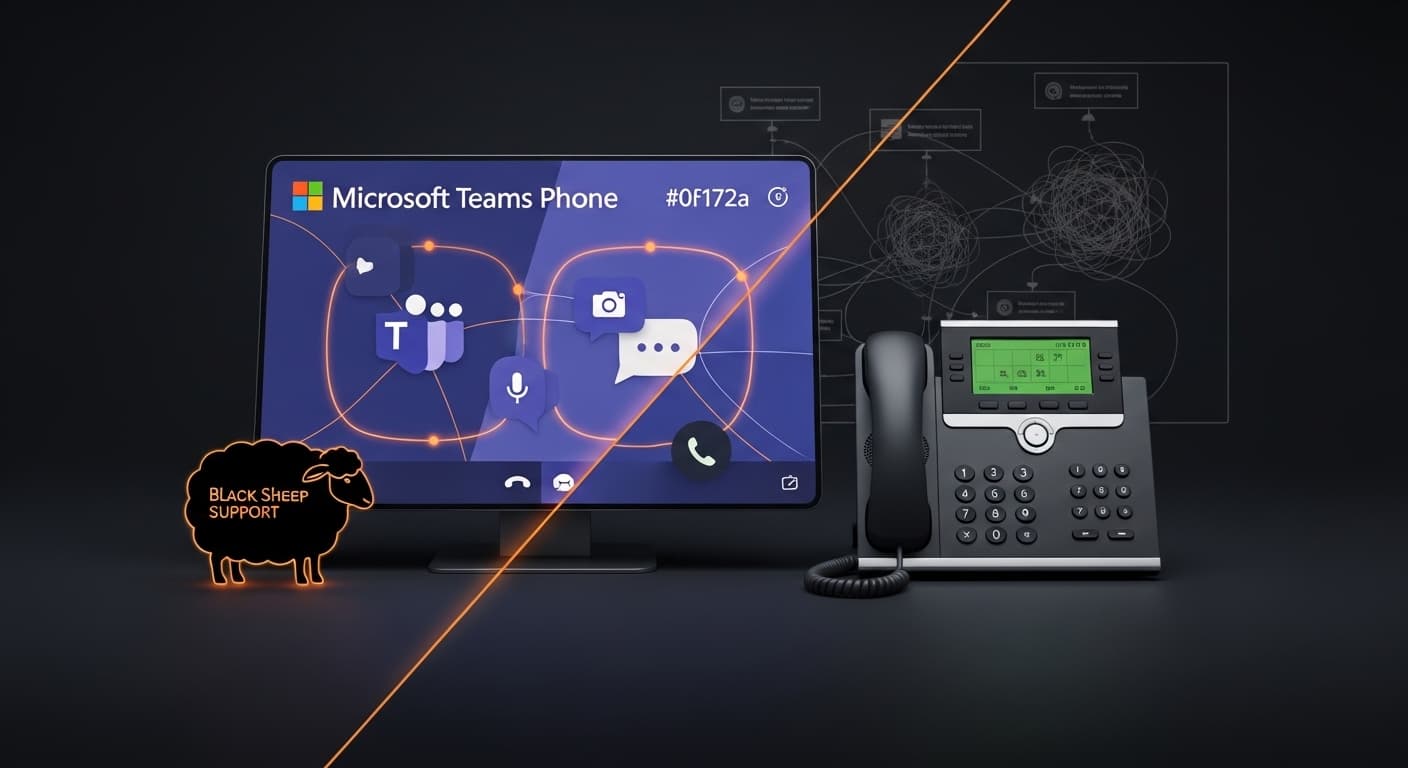

The transition from legacy office telephony to cloud-based communication is no longer a matter of "if," but "when." With the UK’s Public Switched Telephone Network (PSTN) and Integrated Services Digital Network (ISDN) switch-off looming, British SMEs are being forced to retire traditional copper-based phone lines. This deadline, while often framed as "2025," represents a phased retirement that means businesses must act sooner rather than later. For many, the choice boils down to a head-to-head battle: sticking with a dedicated, traditional VoIP (Voice over IP) provider or consolidating communications into the Microsoft Teams Phone ecosystem. As a managed IT provider supporting UK SMEs, we see this decision impact productivity, security, and IT overhead daily. This guide explores the nuances of both systems to help you make an informed decision for your business.
What Microsoft Teams Phone vs Traditional VoIP systems actually means
To understand the difference, we must first define the categories. A "Traditional" VoIP system, often referred to as a Cloud PBX or Hosted Telephony, is a dedicated phone platform. These systems are designed primarily for making and receiving calls over the internet. Providers such as 8x8, RingCentral, or Gamma offer a standalone interface, which typically includes a desktop application, a mobile app, and the option to use physical desk phones. These platforms focus on advanced telephony features like complex call routing, extensive call queues, and detailed call reporting. They operate independently, often requiring a separate login and management portal from your other business applications.
Microsoft Teams Phone, conversely, is an extension of the Microsoft 365 ecosystem. Instead of a separate piece of software, your phone system lives inside the same application your team already uses for chat, video meetings, and file collaboration. It integrates directly with your existing Microsoft 365 user identities and security policies. While both traditional VoIP and Teams Phone use the internet to transmit voice data, the integration level, management overhead, and user experience differ significantly. Teams Phone aims to unify all communication methods into a single interface, whereas traditional VoIP typically remains a distinct application.
Why it matters for UK SMEs
For UK SMEs, the choice between Teams Phone and a traditional VoIP system is not merely technical; it has significant commercial, operational, and compliance implications. The decision affects everything from daily productivity to your cyber security posture and adherence to regulations like UK GDPR.
Firstly, there is the matter of productivity and efficiency. In a typical modern SME, employees juggle multiple applications. Each time a user switches between a chat app, an email client, a CRM, and a separate phone system, there is a measurable loss of focus and efficiency. This "context switching" wastes time and can lead to errors. A unified communication platform, such as Teams Phone, can significantly reduce this friction by keeping all interactions within a single, familiar interface. This consolidation means less time spent navigating different applications and more time focused on actual work.
Secondly, cost and overhead extend beyond the monthly licence fee. A traditional VoIP system introduces another vendor relationship, another invoice, and another support channel. This adds administrative burden and complexity. When issues arise, diagnosing the problem can become a "finger-pointing" exercise between your IT support provider and the VoIP vendor. Consolidating your telephony with your existing Microsoft 365 stack simplifies vendor management and streamlines support, often leading to a lower total cost of ownership (TCO) even if the per-user licence appears similar.
Thirdly, and critically for UK businesses, security and compliance are paramount. The Information Commissioner's Office (ICO) actively enforces UK GDPR, and organisations are expected to demonstrate robust data protection measures. Cyber Essentials certification, a government-backed scheme, also places an emphasis on securing all IT assets. Microsoft invests billions annually in cyber security, and when you use Teams Phone, your telephony traffic benefits from the same enterprise-grade encryption, Conditional Access policies, and Multi-Factor Authentication (MFA) that protects your emails and files. A separate VoIP system, if not secured to the same standard or integrated into your central Identity and Access Management (IAM) system, can become a significant weak point in your overall security posture, potentially exposing your business to NCSC-recognised threats.
Finally, future-proofing and scalability are key considerations. The PSTN switch-off is a clear indicator that legacy infrastructure is being retired. Moving to a fully cloud-native solution ensures your business communication system is resilient, scalable, and adaptable to evolving work patterns, such as hybrid or remote working. A system that can grow with your business and integrate new features without major overhauls offers long-term stability and value.
How to choose and implement your system, a practical walkthrough
Selecting and deploying a new phone system requires careful consideration. It is not just about replacing an old service; it is about optimising communication for your specific business needs. Here is a practical approach to making that decision and ensuring a smooth transition.
1. Assess Your Current and Future Communication Needs
Start by understanding how your team communicates today and how you envision that evolving.
- Call Volume and Type: How many concurrent calls do you typically handle? Are most calls internal or external? Do you have a dedicated sales or support team with high call volumes?
- Key Features: What specific telephony features are non-negotiable? This might include call recording, voicemail-to-email, auto-attendants (IVR), call queues, hunt groups, or conference calling.
- User Profiles: Do all users need the same level of functionality? Some might only need basic calling, while others require advanced features or receptionist consoles.
- Mobility: How important is it for staff to make and receive business calls from mobile devices, laptops, or home offices? The rise of hybrid working makes this a critical point.
2. Evaluate Integration Requirements
The degree to which your phone system integrates with other business applications can significantly impact efficiency.
- Microsoft 365 Reliance: If your team already spends most of its day in Microsoft Teams for chat, video meetings, and file sharing, then Teams Phone offers unparalleled native integration. This minimises "context switching."
- CRM and ERP Systems: Do you need deep integration with a Customer Relationship Management (CRM) system like Salesforce, HubSpot, or Dynamics 365? Many traditional VoIP providers offer robust integrations with popular CRMs, allowing for click-to-dial functionality and automatic call logging. Teams Phone also offers CRM integrations, though the depth can vary.
- Specialised Hardware/Software: Do you have legacy paging systems, door entry systems, or specific industry-standard software that needs to interface with your phone system? Some traditional VoIP providers or on-premise solutions might offer more flexibility for these niche requirements.
3. Consider Security and Compliance
This is not a negotiable point for any UK SME. Your phone system must meet your security obligations.
- Identity and Access Management (IAM): How will users authenticate? Teams Phone integrates directly with Azure Active Directory (now Microsoft Entra ID), leveraging your existing MFA and Conditional Access policies. This means a single identity manages access to all Microsoft 365 services, including telephony.
- Data Protection (UK GDPR): Where is call data stored? How is it protected? Microsoft's global infrastructure and compliance certifications (including those relevant to UK GDPR) mean your Teams Phone data benefits from enterprise-grade security and data residency options. Ensure any traditional VoIP provider can meet similar standards.
- Cyber Essentials: To achieve or maintain Cyber Essentials certification, all internet-facing services must be secured. A standalone VoIP system with weak authentication or an unpatched management portal can easily become a compliance headache. Frankly, we often find this is overlooked. On a recent client tenant audit for a 50-user marketing agency in Leeds, we found their legacy VoIP system still relied on basic password authentication for its admin portal, making it a critical attack vector not covered by their M365 security policies. This was addressed immediately.
4. Analyse Total Cost of Ownership (TCO)
Look beyond the headline monthly fee. The true cost includes licences, hardware, implementation, training, and ongoing support.
- Licensing: Teams Phone typically requires a Microsoft 365 Phone System add-on licence and a Calling Plan (either from Microsoft or a third-party Direct Routing provider). Traditional VoIP is usually a per-user, per-month fee that includes minutes.
- Hardware: Do you need new desk phones? Microsoft Teams-certified desk phones are available, but many users simply use their existing headsets with the Teams desktop or mobile app. Traditional VoIP often encourages or requires specific desk phone models.
- Implementation & Training: Factor in the cost of setting up the system and training your staff. If your team is already familiar with Teams, the training burden for Teams Phone will be significantly lower.
- Support & Management: Consolidating with Microsoft 365 often means fewer vendors to manage and a single point of contact for IT support. This reduces administrative overhead and simplifies troubleshooting.
5. Plan for Implementation and Training
A successful rollout depends on careful planning and user adoption.
- Phased Approach: For larger organisations, consider a phased rollout, perhaps starting with a pilot group.
- User Training: Even with the familiarity of Teams, specific training on call handling, voicemail, and advanced features is crucial.
- Number Porting: Plan for porting your existing business numbers. This process requires coordination and can take several weeks.
- Network Readiness: Ensure your internet connection is robust enough to handle voice traffic. VoIP, whether Teams or traditional, relies on a stable and sufficiently fast internet connection.
At Black Sheep Support, we advocate for solutions that align with your existing IT infrastructure and simplify management. When we onboarded a 40-user London accountancy firm last quarter, their disparate communications systems (separate VoIP, chat, video) were causing significant productivity drag. Consolidating to Teams Phone was the first thing we addressed, resulting in a measurable reduction in context-switching complaints and a clearer security posture. Deployment for Teams Phone is essentially a configuration task within your existing Microsoft 365 tenant, and because your team is likely already familiar with the Teams interface, the learning curve is significantly flatter. When a user reports "I can't hear the caller," our engineers can troubleshoot the Teams client, the network, and the M365 configuration in one place, rather than navigating between multiple vendor dashboards.
Common mistakes we see
Even with careful planning, businesses sometimes stumble when transitioning their telephony. Here are a few common pitfalls:
- Underestimating Integration Benefits: Many businesses focus solely on telephony features and overlook the significant productivity gains from having communications unified within a single platform like Microsoft 365.
- Focusing Only on Licence Cost: The cheapest per-user licence does not always equate to the lowest total cost of ownership. Hidden costs in management, support, and security often outweigh initial savings.
- Neglecting Security Implications of Separate Systems: Treating a standalone VoIP system as a separate entity from your main IT security strategy leaves a potential backdoor into your business, especially if MFA is not uniformly applied.
- Ignoring User Adoption and Training: A powerful system is useless if your team does not know how to use it effectively. Proper training and change management are crucial for a smooth transition.
- Failing to Plan for the PSTN Switch-off Properly: Assuming that all existing VoIP systems are "future-proof" without verifying their underlying network architecture can lead to unexpected issues as legacy infrastructure is decommissioned.
Key Takeaways
When choosing between Microsoft Teams Phone and a Traditional VoIP system, consider these critical factors:
- Consolidation is Key: Reducing the number of software vendors simplifies IT management, streamlines support, and reduces your "attack surface" for cyber threats.
- Security Integration: Microsoft Teams Phone leverages your existing M365 security stack, making it easier to maintain UK GDPR compliance and align with NCSC guidance.
- The User Experience: If your team lives in Teams for daily collaboration, keeping their telephony within the same application minimises app-switching, increasing focus and efficiency.
- Specialised Needs: If your business relies on a high-volume call centre, complex hunt groups, or requires integration with niche legacy hardware, carefully evaluate the specific reporting and routing features of dedicated VoIP providers before committing solely to Teams.
- The PSTN Switch-off: Ensure your chosen solution is fully cloud-native and future-proofed to avoid the pitfalls of the ongoing retirement of traditional phone lines.
Ultimately, for most UK SMEs, Microsoft Teams Phone offers a superior blend of security, integration, and ease of management. It is a strategic move that aligns your telephony with your digital transformation goals rather than treating it as a siloed utility. It also reduces the number of vendors you need to deal with, which is rarely a bad thing.
To take the next step