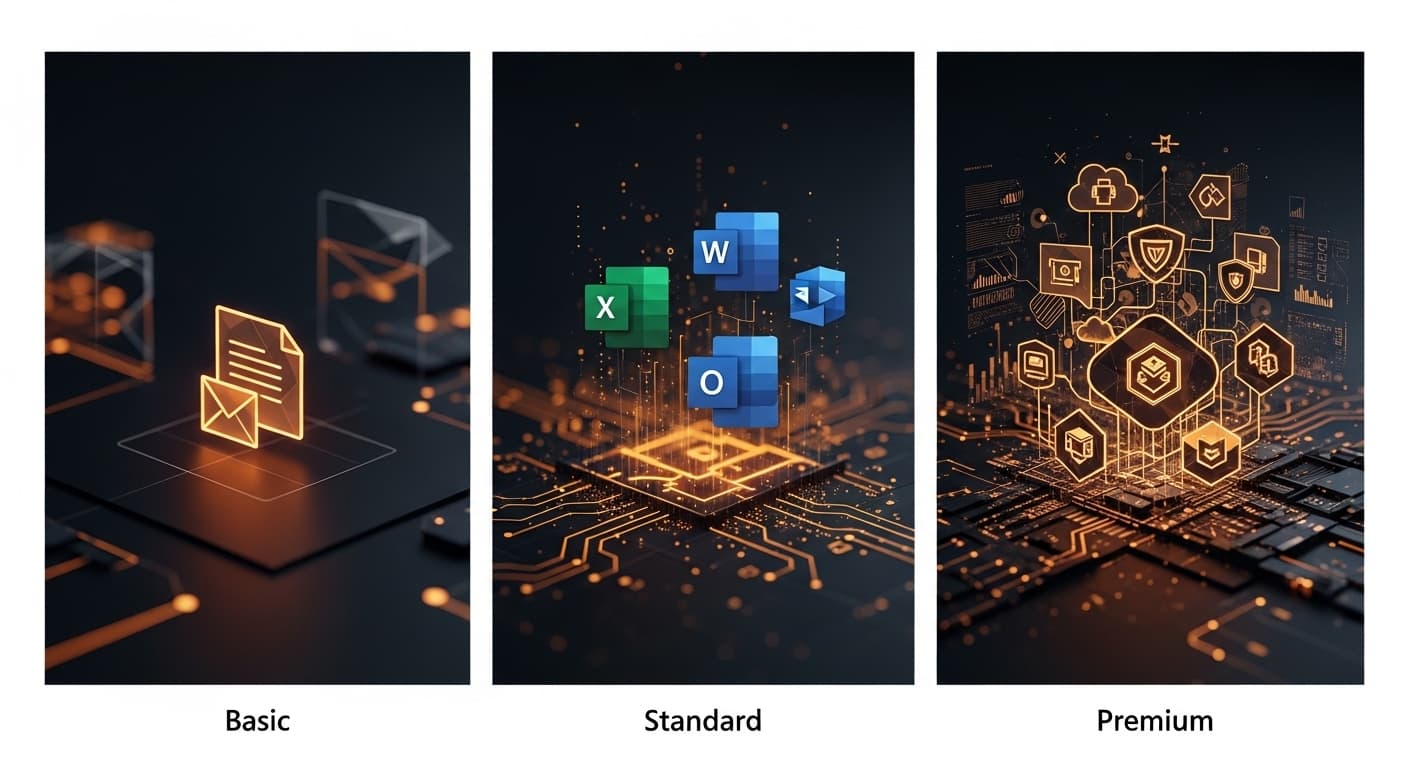

Microsoft 365 is the digital backbone of the modern UK SME. Whether you are a boutique creative agency in London or a manufacturing firm in the Midlands, the way you manage your documents, emails, and collaborative workflows dictates your operational efficiency. However, Microsoft’s licensing structure is notoriously complex. Choosing between Business Basic, Business Standard, and Business Premium is not just a decision about monthly overheads—it is a strategic choice regarding your company’s productivity, data sovereignty, and cyber security posture.
As a managed IT provider working with hundreds of UK businesses, we frequently see SMEs overpaying for features they do not use, or worse, leaving themselves critically exposed by opting for a lower tier that lacks essential security controls. This guide cuts through the marketing jargon to help you align your Microsoft 365 licensing with your business goals and the current UK regulatory landscape.
What Microsoft 365 Licensing actually means
At its core, Microsoft 365 is a subscription service providing access to a suite of productivity and collaboration tools, hosted by Microsoft in the cloud. Think of it as renting your office software and services rather than buying them outright. This includes familiar applications like Word, Excel, Outlook, and PowerPoint, alongside critical infrastructure services such as email hosting (Exchange), cloud storage (OneDrive and SharePoint), and communication platforms (Teams). Your licence determines precisely which applications and services you can use, the features available within them, and crucially, the level of integrated security. It is not just about getting the software; it is about accessing a comprehensive platform designed to support modern business operations.
Why it matters for UK SMEs
For a UK SME, your Microsoft 365 licensing choice has direct commercial implications that extend far beyond the monthly bill. Incorrect licensing can lead to significant operational inefficiencies, compliance failings, and substantial cyber security vulnerabilities.
Firstly, productivity. If your team lacks the appropriate tools, workflows become clunky, staff frustration increases, and output suffers. This translates directly to lost revenue and competitive disadvantage. Secondly, compliance. The Information Commissioner’s Office (ICO) in the UK takes a dim view of organisations that fail to implement "appropriate technical and organisational measures" to protect personal data under GDPR. A basic licence simply does not provide the necessary security framework to meet these obligations for most businesses handling client or employee data. Fines for non-compliance can be substantial, and the reputational damage can be irreparable. Finally, cyber security. The National Cyber Security Centre (NCSC) consistently highlights phishing and ransomware as primary threats to UK SMEs. Opting for a lower-tier licence often means foregoing essential, enterprise-grade security tools that could prevent a breach, protect your data, and keep your business operational. This is not merely an IT concern; it is a fundamental business risk that requires careful consideration.
How to choose your Microsoft 365 licence: A Practical Walkthrough
Deciding on the right Microsoft 365 licence tier requires a clear understanding of what each offers and, more importantly, what it lacks. We will break down the key features and considerations for Business Basic, Business Standard, and Business Premium.
Microsoft 365 Business Basic: The Cloud-First Approach
Microsoft 365 Business Basic is often viewed as the entry-level tier for businesses that are "cloud-first." It is designed for organisations that primarily work through a web browser or have staff who move frequently between devices without needing local software installations.
What you get: Business Basic provides the essential suite of services:
- Exchange Online: Professional email hosting with a 50GB mailbox per user, custom domain support, and calendaring.
- OneDrive for Business: 1TB of personal cloud storage per user, allowing access to files from any device.
- SharePoint Online: For team sites, intranets, and collaborative document management.
- Microsoft Teams: For chat, video conferencing, and team collaboration.
- Web versions of Office apps: Word, Excel, PowerPoint, and Outlook are accessible through a web browser.
When is it the right choice?
- Frontline workers: Staff who do not require heavy desktop software, such as warehouse floor managers, retail staff, or field operatives who primarily use mobile devices or tablets for communication and basic data entry.
- Budget-conscious startups: If your team is genuinely comfortable working entirely within the web versions of Office applications, this offers the most cost-effective way to maintain a professional business domain and secure cloud storage.
- The "Zero-Hardware" approach: If your business is shifting towards virtual desktop infrastructure (VDI), where the operating system and applications are hosted elsewhere, the local installation of Office is redundant.
However, for most UK SMEs, relying solely on web-based apps can lead to friction. If your staff frequently handle complex spreadsheets, large PowerPoint decks, or require specific add-ins, the web-based versions often lack the advanced features and processing power of the desktop applications. This can hinder productivity and create unnecessary workarounds.
Microsoft 365 Business Standard: Unlocking Productivity
For the majority of UK office-based SMEs, Business Standard is often considered the "sweet spot." It includes everything found in Business Basic, but adds the heavy-hitting desktop applications that have defined the modern office for decades.
Why desktop apps still matter: While the cloud is undeniably the future, the desktop versions of Word, Excel, Outlook, and PowerPoint remain the industry standard for a reason. They offer:
- Offline capability: You can work on documents without a stable internet connection, with changes syncing automatically once you reconnect. This is invaluable for staff working remotely or travelling.
- Advanced functionality: Features like complex Excel macros, advanced formatting in Word, deep integration with third-party plugins, and full Outlook functionality are typically only available on the desktop versions.
- Performance: Handling massive datasets, high-resolution media files, or multiple large documents simultaneously is significantly smoother and faster on a local machine than over a browser interface.
The hidden risk of Standard: While Business Standard is excellent for productivity, it is important to note that it offers very little in the way of advanced security. It provides a baseline, certainly more secure than consumer-grade alternatives, but it lacks the enterprise-level device management, identity protection, and advanced threat detection capabilities that are increasingly necessary. If you are handling sensitive client data, processing payroll, or operating in a sector governed by strict data privacy laws (which, candidly, is most UK SMEs), Standard alone is rarely sufficient to meet regulatory expectations or defend against modern cyber threats.
Microsoft 365 Business Premium: The Security Imperative
If you are serious about cyber security—and in the current climate of UK ransomware attacks and data breaches, you absolutely should be—Business Premium is the only logical choice for the modern SME. It provides the productivity tools of Business Standard alongside a comprehensive suite of advanced security and device management features.
Why Premium is a security necessity: Business Premium includes everything in Standard, but adds a suite of advanced security tools that are essential for meeting the requirements of the UK’s Cyber Essentials certification, NCSC recommendations, and GDPR compliance.
- Microsoft Defender for Business: This is enterprise-grade endpoint protection for Windows, macOS, Android, and iOS devices. It goes far beyond standard antivirus, offering AI-driven threat detection, automated investigation, and response capabilities that can stop ransomware, malware, and other advanced threats before they compromise your systems.
- Intune (Device Management): This allows you to manage and secure company-owned and personal devices (BYOD) remotely. You can enforce security policies (e.g., strong passwords, encryption), deploy applications, and crucially, wipe business data from a lost or stolen device instantly. This ensures your intellectual property remains secure even if physical hardware is compromised.
- Conditional Access: This is the "gold standard" of identity security. You can set granular rules that prevent logins from suspicious locations (e.g., foreign countries), require Multi-Factor Authentication (MFA) every time a user accesses sensitive applications or files, or block access from non-compliant devices. This significantly reduces the risk of account compromise. On a recent client tenant audit for a 30-user engineering firm in Bristol, we found over 70% of accounts lacked Multi-Factor Authentication (MFA) enforcement, a basic control that Business Premium's Conditional Access policies can readily mandate.
- Azure Information Protection (AIP): This allows you to classify, label, and protect documents and emails. You can ensure that a sensitive PDF, for example, cannot be forwarded to an external email address or printed, even if it is attached to an email. This is crucial for Data Loss Prevention (DLP).
- Data Loss Prevention (DLP) Policies: Beyond AIP, Premium offers advanced DLP capabilities to set policies that automatically flag or block the sharing of sensitive information (like bank account numbers or National Insurance numbers) in emails, Teams chats, or SharePoint documents.
- Advanced Threat Protection (ATP) for Email: This enhances Exchange Online Protection (EOP) with features like Safe Attachments (scans email attachments for malware in a sandbox environment before delivery) and Safe Links (rewrites URLs in emails to scan for malicious content at the time of click). This protects your users from sophisticated phishing emails, which remain the primary entry point for cyber criminals targeting UK SMEs.
For any UK SME handling PII (Personally Identifiable Information), Business Premium is not just an IT expense; it is an insurance policy against data breaches, regulatory fines from the ICO, and the significant business disruption that a cyber attack can cause.
Strategic Decision Making: A Framework for SMEs
To decide which licence is right for you, we recommend a simple audit of your current operations and future plans.
The "Needs Assessment" Checklist:
- Do your staff work offline, or require advanced features in desktop applications? If yes, you need at least Business Standard.
- Do you handle sensitive client data, employee PII, or financial records? If yes, you need Business Premium to stay compliant with GDPR and adequately protect that data.
- Do you have a remote or hybrid workforce, or staff using mobile devices for work? If yes, Intune (included in Premium) is essential for securing and managing devices that are not always on your office network.
- Are you aiming for Cyber Essentials or Cyber Essentials Plus certification? If yes, the security controls in Business Premium (Defender, Intune, Conditional Access) will do much of the heavy lifting for your application, making certification significantly more straightforward.
- Do you need to protect against sophisticated phishing, ransomware, or insider threats? Business Premium offers the advanced threat protection and data loss prevention capabilities required.
The Hybrid Approach: One of the most effective strategies we implement for our clients is a "mixed-licence environment." You do not have to put every employee on the same tier. This allows for cost optimisation without compromising critical security.
- Provide Business Premium to your management, finance, HR, and IT teams who access the most sensitive data and require the highest level of protection.
- Provide Business Standard to your general office staff, sales teams, or project managers who primarily need desktop apps for daily productivity but may not handle the most sensitive data directly.
- Use Business Basic for contractors, seasonal staff, or frontline workers who only need email, cloud storage, and basic document access via web browsers or mobile devices.
This tiered approach allows you to optimise your monthly spend while ensuring that your most critical data and users are shielded by the highest level of protection available.
Common mistakes we see
- Under-licensing critical users: Assuming Business Standard is sufficient for finance or HR staff handling sensitive data, leaving a significant security gap.
- Over-licensing non-essential users: Paying for Business Premium for every user, including those who only need email and web apps, leading to unnecessary expenditure.
- Failing to configure security features: Purchasing Business Premium but not properly implementing or managing features like Conditional Access or Defender, negating its value.
- Ignoring Multi-Factor Authentication (MFA): Not enforcing MFA across the organisation, even when the licence tier supports it, which is arguably the easiest and most effective security control.
- Treating M365 as a complete backup solution: Relying solely on OneDrive and SharePoint for data retention without a separate, dedicated backup strategy for M365 data.
Key Takeaways
- Business Basic is for web-centric, light-duty users; it lacks the desktop power many businesses rely on.
- Business Standard is the professional standard for productivity, providing the desktop apps (Word, Excel, etc.) that UK businesses need to function efficiently.
- Business Premium is a security-first licence that provides the essential protections (Defender, Intune, Conditional Access) required to defend against cyber threats and meet GDPR and Cyber Essentials standards.
- Don't overspend: You can mix and match licences across your user base to balance budget with security requirements.
- Security is not optional: In the current UK threat landscape, relying on low-tier licences for staff handling sensitive data is a business risk you cannot afford to ignore. The alternative, of course, is a conversation with the ICO, which tends to be rather less accommodating than our sales team.
Choosing the right Microsoft 365 licence is about more than just software; it’s about building a robust, compliant, and efficient foundation for your business to scale safely. If you are still unsure which mix of licences is right for your team, or if you need help auditing your current security posture, we are here to help.
To take the next step