
For many UK SMEs, the phone remains the lifeblood of customer relationships. Whether you are managing sales leads, providing technical support, or coordinating logistics, the voice call is where critical business happens. However, when your CRM (Customer Relationship Management) system and your VoIP (Voice over IP) phone system operate in silos, you create a "data gap." Your team ends up wasting valuable time manually logging calls, searching for contact details, and toggling between browser tabs. Integrating these two essential tools isn't just about convenience, it is a strategic move to improve productivity, enhance the customer experience, and ensure your data remains compliant with UK regulations, all while providing a clearer picture of your operational efficiency.
What CRM with VoIP integration actually means
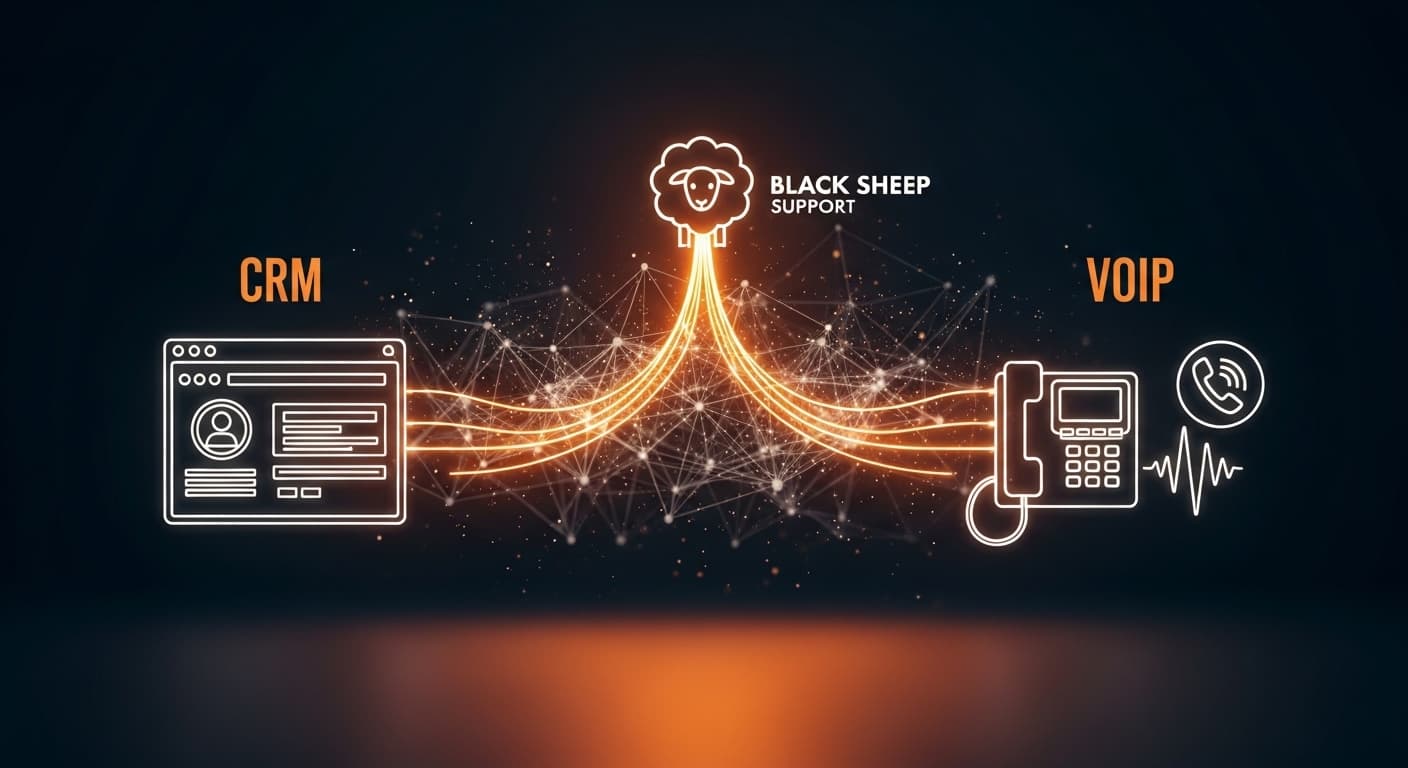
At its core, CRM with VoIP integration means connecting your customer relationship management system with your internet-based phone system. Rather than two separate applications, they become a single, unified communications platform. When a call comes in, or you make an outbound call, the systems communicate. Your CRM can tell the VoIP system who is calling or who you are calling, and the VoIP system can log that interaction back into the CRM. This isn't just about displaying a name; it’s about sharing data, automating routine tasks, and providing context to every conversation. It transforms your phone system from a simple communication device into an intelligent data capture and retrieval tool directly linked to your client records.
Why it matters for UK SMEs
In the competitive UK market, efficiency, customer experience, and regulatory compliance are not optional; they are fundamental. For UK SMEs, operating with disconnected systems is a significant handicap.
Firstly, there's the commercial framing. Staff time is a finite and expensive resource. Manual data entry and cross-referencing between systems are unproductive, draining hours that could be spent on revenue-generating activities or direct customer engagement. When a sales representative spends five minutes after each call manually updating a CRM, those minutes compound rapidly across a team, becoming hours, then days, of lost productivity annually. This directly impacts your bottom line and your capacity for growth.
Secondly, compliance is non-negotiable. As a UK-based business, you are bound by the UK GDPR and the Data Protection Act 2018. The Information Commissioner’s Office (ICO) actively monitors data handling practices. Operating with fragmented customer data across disparate systems significantly elevates the risk of non-compliance. An integrated system helps centralise your data, making it easier to manage customer consent, honour rights to erasure, and maintain accurate audit trails, which are all critical for regulatory adherence. Furthermore, for businesses pursuing accreditations like Cyber Essentials, demonstrating control over your data flows and communication channels is a key component of your cyber defence strategy, aligning with NCSC recommendations for good practice. An integrated solution can contribute positively to these frameworks by creating a more controlled and auditable environment for sensitive customer interactions.
How to integrate your CRM with your VoIP phone system, a practical walkthrough
Implementing CRM-VoIP integration is a strategic project that touches multiple facets of your business. The goal is to create a cohesive environment where communication and customer data are inextricably linked, providing a tangible return on investment.
Boosting Productivity Through Automation
The most immediate and tangible benefit is the radical reduction in manual administrative tasks. Automation ensures your team spends more time interacting with customers and less time on data entry.
-
Automated Call Logging: Every inbound and outbound call is automatically logged against the relevant contact record in your CRM. This creates an immutable, timestamped audit trail of all interactions. This record includes call duration, time, and often the direction (inbound/outbound). If a team member is absent or moves to a new role, a colleague can instantly review the complete communication history, ensuring continuity and reducing the need for repeat questions from the client. This also provides valuable data for performance reviews and dispute resolution.
-
Click-to-Dial Functionality: This feature transforms every phone number within your CRM into a clickable link. Clicking it initiates a call directly from your VoIP system. The benefits are two-fold: it eradicates the common error of "fat-fingering" numbers, typing incorrect digits and calling the wrong client, and it saves seconds on every call. Across a team making hundreds of calls a day, these seconds aggregate into hundreds of hours of reclaimed productivity over a year. It's a small change with a significant cumulative impact on operational efficiency.
-
Screen Pops: When an incoming call is received, the integrated system automatically identifies the caller using their phone number and presents their CRM record on the agent's screen before they even answer. This "screen pop" provides immediate context, allowing the agent to greet the caller by name, understand their history, and access relevant information (previous purchases, support tickets, outstanding queries) instantly. This eliminates the need for the agent to ask repetitive identification questions, drastically speeding up the interaction.
-
Call Recording & Transcription: For many UK businesses, particularly those in regulated industries, call recording is a compliance requirement. Integrated systems can automatically record calls and store them directly within the corresponding CRM record. Some advanced systems also offer transcription services, converting spoken words into searchable text. This not only aids compliance but also provides invaluable material for staff training, quality assurance, and detailed dispute resolution, offering a clear record of what was agreed or discussed.
Enhancing the Customer Experience (CX)
In a competitive market, customer experience is often the primary differentiator. An integrated system allows you to deliver a more personalised, efficient, and professional service.
-
Personalised Greetings: With screen pops providing instant caller identification and history, your staff can greet callers by name and reference their previous interactions. "Hello Mr. Smith, I see you were enquiring about our new service package last week, how can I help?" This level of personalisation builds immediate trust and rapport, making the customer feel valued rather than just another number.
-
Reduced Hold Times and Faster Resolution: Because your staff has immediate access to the client’s account history, status, and previous tickets, they don’t need to put the client on hold to "look that up." This efficiency translates directly into shorter call times and quicker problem resolution, significantly improving customer satisfaction and reducing frustration.
-
Contextual Routing: Advanced integrations can leverage CRM data to intelligently route calls. For example, a high-value account holder or a customer with an open high-priority support ticket can be automatically routed to their dedicated account manager or a specialist support queue, bypassing general reception. This ensures the customer reaches the most appropriate person quickly, enhancing their experience and improving resolution rates.
-
Empowered Self-Service: For businesses utilising Interactive Voice Response (IVR) systems, integration allows the IVR to pull data directly from the CRM. This means customers can access personalised information (e.g., order status, account balance) through automated prompts without needing to speak to an agent, streamlining common queries and freeing up staff for more complex issues.
Data Integrity and GDPR Compliance
Managing customer data across disparate systems is a recipe for compliance headaches and operational inefficiency. Integration is crucial for maintaining data accuracy and meeting regulatory obligations.
-
Centralising the "Single Source of Truth": When data resides in two separate places (e.g., a phone system's local directory and a CRM), it inevitably drifts. A client's phone number might be updated in the CRM but not in the VoIP system, leading to confusion and errors. By integrating, the CRM becomes your single, authoritative source of truth for customer contact information. Any update in the CRM propagates to the VoIP system, ensuring consistency and accuracy across all platforms.
-
Secure Call Recording Management: If your industry requires call recording for compliance or training, an integrated system allows you to store those recordings securely within the CRM, directly linked to the specific client profile. This centralisation makes it significantly easier to retrieve evidence if a dispute arises, demonstrate compliance during an ICO audit, or respond to data subject access requests. It helps prevent recordings from being stored in unsecured, unlinked locations.
-
Right to Erasure and Correction: Under UK GDPR, individuals have the "Right to Erasure" (the right to be forgotten) and the "Right to Rectification." When your CRM is the central data repository, deleting or correcting a client's record from there ensures it is removed or updated across your integrated contact lists and communication logs. This significantly reduces the risk of accidental non-compliance, such as inadvertently contacting a customer who has exercised their right to be forgotten.
-
Comprehensive Audit Trails: An integrated system provides a robust, centralised audit trail of all customer interactions, emails, notes, and now, detailed call logs and recordings. This comprehensive record is invaluable for demonstrating compliance, investigating incidents, and understanding customer history in a holistic manner.
Gaining Actionable Insights with Data Analytics
Most VoIP systems provide basic call metrics, and CRMs provide sales or support metrics. Integration allows you to combine these for a truly "big picture" view of your business performance, moving beyond raw data to actionable insights.
-
Conversion Tracking and Sales Performance: You can correlate the number of calls made by a sales representative with the number of closed deals or pipeline progression recorded in the CRM. This allows you to identify top performers, understand effective communication patterns, and pinpoint areas where additional coaching or resources may be needed. It moves beyond simply tracking activity to tracking activity that leads to results.
-
Call Outcome Analysis and Resource Optimisation: By enabling agents to tag calls in the CRM (e.g., "Sales enquiry," "Support ticket," "Complaint," "Resolved"), you can run sophisticated reports. This data reveals which departments are receiving the highest volume of specific call types, allowing you to adjust staffing levels, refine training programmes, or even identify systemic issues that generate particular types of customer contact.
-
ROI on Marketing Campaigns: If you utilise unique phone numbers for specific marketing campaigns (e.g., a number for a digital ad, another for a print ad), integrating these with your CRM allows you to track exactly which campaigns are driving the most inbound leads, and critically, which of those leads convert into actual business. This provides precise data to optimise your marketing spend.
-
Agent Performance and Quality Assurance: Beyond just call numbers, an integrated system can link call data directly to customer outcomes in the CRM. You can assess an agent's efficiency not just by how many calls they handle, but by their first-call resolution rate, customer satisfaction scores (recorded in the CRM), and even the value of the deals they close. This provides a more holistic view of agent effectiveness.
Choosing the Right Integration Path
Not all VoIP systems integrate with all CRMs equally, and the depth of integration can vary significantly. Understanding your options is crucial before committing to a solution.
-
Native Integrations: These are purpose-built integrations developed directly by the software vendors (e.g., Salesforce integrating with a specific VoIP provider). They are typically the most stable, easiest to set up, and receive regular updates and support directly from the providers. Always check if your current VoIP and CRM providers offer a native "plug-and-play" module for each other. They usually offer the richest feature set.
-
Middleware (e.g., Zapier, Make): If a native integration doesn't exist or doesn't meet all your specific requirements, you can use middleware platforms. These tools act as a bridge, allowing different applications to exchange data. While powerful and flexible, they can be more complex to configure and maintain. They may also introduce a slight latency in data synchronisation and rely on the stability of a third-party service. It's worth noting that while they offer flexibility, they often don't provide the deep, real-time functionality of a native integration, such as screen pops.
-
API Development: For larger SMEs with highly unique workflows, or specific legacy systems, custom API (Application Programming Interface) development is an option. This involves building bespoke code to connect the two systems directly. This provides the ultimate flexibility and control but is the most complex, time-consuming, and expensive approach. It requires significant technical expertise to design, implement, and maintain. This is where Black Sheep Support can assist, providing the engineering expertise to ensure that the data flows securely and efficiently between your platforms, tailored precisely to your operational needs. We recently onboarded a 30-user architectural practice in Manchester. Their legacy PABX and disconnected CRM meant daily data entry. Our first step was evaluating their CRM (Salesforce) and proposing a native VoIP integration, which immediately cut administrative time by an estimated 1.5 hours per user per week. The awkward truth is, many SMEs underestimate the time sink of manual processes.
Common mistakes we see
- Underestimating the complexity: Assuming all integrations are simple "plug-and-play" overlooks the nuances of data mapping, user permissions, and workflow adjustments.
- Skipping user training: Providing powerful tools without adequate training on how to use them effectively means staff default to old habits, negating much of the benefit.
- Ignoring data security implications: Not properly securing the data flow between systems or failing to implement appropriate access controls can create new vulnerabilities.
- Choosing solely on price: Opting for the cheapest integration option often results in limited functionality, poor stability, or a lack of support, leading to greater costs down the line.
- Failing to define clear objectives: Without clear goals (e.g., "reduce call handling time by 15%"), it's impossible to measure the success of the integration or justify the investment.
Key Takeaways
- Eliminate Manual Labour: Automate call logging and dialling to save your team hours every week, freeing them for more valuable tasks.
- Elevate Service: Use instant "screen pops" and contextual routing to provide a personalised, high-touch customer experience that builds loyalty.
- Maintain Compliance: Centralise your customer data to ensure accuracy and meet UK GDPR and ICO standards, reducing compliance risks.
- Measure What Matters: Combine call data with CRM insights to gain a clearer, actionable understanding of sales performance and operational efficiency.
- Work with Experts: Integration is a technical and strategic task; ensure your IT partner understands both your telephony infrastructure and your data security requirements to avoid creating vulnerabilities or implementing a sub-optimal solution.
Integrating your CRM and VoIP system is not merely an IT project; it is a business transformation initiative. It creates a seamless flow of information that empowers your staff, delights your customers, and provides the management team with the data necessary to make informed decisions. In an era where efficiency and customer experience are paramount, this is one of the highest-impact changes a UK SME can make to its digital infrastructure.
To take the next step