
In the current threat landscape, it is no longer a question of if your UK SME will face a cyber security incident, but when. Ransomware has evolved from a nuisance into a sophisticated, industrialised business model for cybercriminals. For small and medium-sized enterprises, a successful ransomware attack can be catastrophic, leading to prolonged operational downtime, significant financial loss, and severe reputational damage. While firewalls, endpoint detection, and staff training remain essential components of a layered security strategy, these measures are not infallible. When the perimeter is breached and your local systems are encrypted, your ability to recover hinges entirely on the integrity of your data backups. This guide explores why cloud-based backups are not merely a storage solution, but your definitive last line of defence against total business collapse.
What Ransomware Recovery Actually Means
Ransomware recovery, at its core, refers to the process of restoring your business operations and data after a ransomware attack has encrypted your systems. This involves identifying the extent of the infection, isolating affected systems, and then systematically restoring data from clean backups to bring your IT infrastructure back online. It is about minimising the disruption, avoiding ransom payments, and ensuring business continuity. Cloud backups play a critical role here by providing an off-site, protected copy of your data that is isolated from your primary network, making it impervious to the attack that compromised your live systems. Without reliable backups, "recovery" often devolves into rebuilding from scratch or capitulating to a cybercriminal's demands, neither of which are desirable outcomes.
Why It Matters for UK SMEs
Cybercriminals often view UK SMEs as "low-hanging fruit." Many business owners mistakenly believe their company is too small to be targeted. However, the reality is that hackers use automated scanning tools to find vulnerabilities in remote desktop protocols (RDP), unpatched software, or weak email security, regardless of the size of the company. Once inside, the goal of the attacker is to gain administrative access, exfiltrate sensitive data, and encrypt your digital assets. The commercial implications for an SME are stark. Beyond the immediate operational standstill, there are significant financial costs associated with recovery, potential revenue loss during downtime, and the broader damage to client trust and market reputation.
Under the UK General Data Protection Regulation (UK GDPR), if that data includes personal information, you are legally obligated to report the breach to the Information Commissioner’s Office (ICO). Failure to have appropriate technical and organisational measures in place, such as robust backups, can lead to substantial fines, in addition to the operational disruption. The National Cyber Security Centre (NCSC) consistently highlights the importance of backups as a critical control for organisational resilience. Furthermore, for businesses seeking to demonstrate a baseline level of cyber security, the UK government’s Cyber Essentials scheme explicitly requires a sound backup strategy, including off-site copies, to achieve certification. Relying on local backups—such as external hard drives or network-attached storage (NAS) connected to your primary network—is a dangerous gamble. Modern ransomware is designed specifically to locate and encrypt these connected backup devices first, effectively neutralising your ability to restore your data without paying the ransom. For many SMEs, a successful, unrecoverable ransomware attack can be an existential threat.
How to Implement Your Last Line of Defence
Implementing an effective ransomware recovery strategy requires a methodical approach, with cloud backups forming the bedrock. This isn't merely about ticking a box; it's about building genuine resilience.
Cloud Backups vs. Traditional Methods
Traditional backup methods, such as tape drives or local USB storage, suffer from inherent physical vulnerabilities. They can be stolen, damaged by fire or flooding, or simply corrupted over time. Furthermore, if your physical office is inaccessible or compromised, your local backups become unreachable.
Cloud-based backups offer a significant improvement in data resilience. By placing your data in an off-site repository, you remove the physical dependency on your office infrastructure. Your data is stored in secure, geographically dispersed data centres. If a fire or flood hits your office, your data remains safe. Crucially, advanced cloud backup solutions use "air-gapping" techniques, where data is pushed to a secure environment that is not directly accessible by your local network. This makes it invisible to ransomware seeking targets to encrypt. The data is often stored in an immutable format, meaning it cannot be altered, deleted, or encrypted once written for a specified retention period, even by an attacker who gains administrative access to your primary network. As your business grows, your storage needs fluctuate. Cloud solutions allow you to scale your capacity instantly without the need to purchase new hardware, providing flexibility and cost efficiency.
Adopting the 3-2-1-1 Backup Strategy
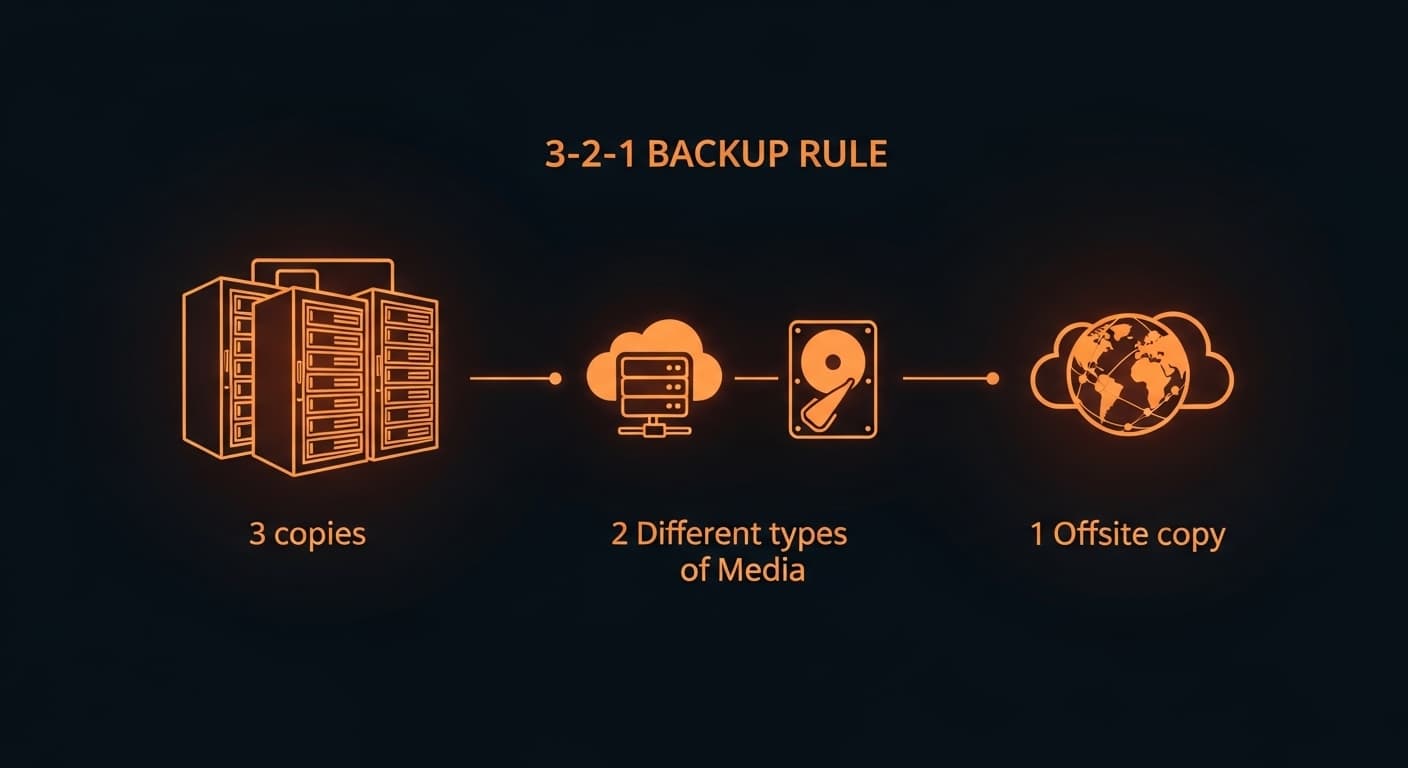
At Black Sheep Support, we advocate for the gold standard in data protection: the 3-2-1-1 backup strategy. This framework ensures that even in a worst-case scenario, you have multiple avenues for recovery.
- 3 Copies of Data: Maintain at least three copies of your data (the primary production data and two backups). This redundancy significantly reduces the risk of data loss from a single point of failure.
- 2 Different Media Types: Store your backups on two different types of storage media (e.g., local server storage for fast recovery and cloud storage for off-site resilience). This protects against media-specific failures.
- 1 Off-Site Copy: Keep at least one copy in an off-site location, such as a secure cloud environment. This is essential for disaster recovery in the event your primary site becomes inaccessible or compromised.
- 1 Immutable Copy: This is the critical modern addition for ransomware defence. Ensure at least one copy is "immutable" or "WORM" (Write Once, Read Many). This means the data cannot be altered, deleted, or encrypted by any user or piece of software for a set period, rendering ransomware attacks ineffective against your backup files. This immutability is the definitive last stand against ransomware.
We recently onboarded a 30-user engineering firm in Birmingham. Their existing "backup solution" was a single external hard drive, stored next to the server it was backing up. This setup offered no protection against fire, theft, or, critically, ransomware. The first thing we addressed was implementing a secure, off-site cloud backup system with immutable storage, ensuring their operational data was adequately protected.
Meeting Compliance and NCSC Guidance
For UK SMEs, compliance is not just about avoiding fines; it is about demonstrating to your clients and partners that you are a trustworthy custodian of their data. The UK government’s Cyber Essentials scheme explicitly highlights the importance of robust backup processes. To achieve certification, organisations must demonstrate that they have an appropriate backup strategy in place, including regular testing and off-site storage.
The ICO expects businesses to have "appropriate technical and organisational measures" in place to protect personal data. If you suffer a ransomware attack and cannot restore data because your backups were also encrypted, you may be found in breach of the GDPR for failing to ensure the "ongoing confidentiality, integrity, availability, and resilience" of your processing systems. Implementing cloud backups with encryption at rest and in transit provides the technical evidence required to prove you have taken due diligence to safeguard sensitive information. The NCSC’s "Small Business Guide" also clearly states the necessity of backing up your data regularly and storing it securely, advising that backups should be offline or off-site to prevent them from being affected by the same incident.
Testing Your Disaster Recovery Plan
A backup is not a recovery plan. Many businesses discover the hard way that their backups are incomplete, corrupted, or incompatible with their current systems only when they attempt to restore them during an emergency.
- Restore Testing: Every month, perform a "mock restore" of a random subset of your data. This should involve attempting to recover files to a separate, isolated environment to verify their integrity and usability. If you can’t restore it, you don’t have a backup.
- Recovery Time Objective (RTO) and Recovery Point Objective (RPO): Define your RTO—the maximum time your business can afford to be offline—and your RPO—the maximum amount of data your business can afford to lose. Ensure your cloud backup provider can meet these targets through high-speed restoration features and frequent backup intervals.
- Documented Recovery Procedures: Create a "Runbook." This is a step-by-step document that outlines exactly who does what when a ransomware event is detected. It should include contact details for your IT provider, your insurance company, and the ICO. This document should be stored both digitally (in a separate, secure location) and physically.
- Regular Drills: Conduct periodic, full-scale disaster recovery drills, involving key staff. This is not just an IT exercise; it’s a business continuity exercise.
Common Mistakes We See
Despite the clear risks, we frequently observe several recurring errors in SME backup strategies:
- Sole Reliance on Local Backups: Many businesses still depend entirely on external hard drives or network-attached storage connected directly to their network, leaving them vulnerable to ransomware encryption.
- Untested Backups: Assuming backups are functional without ever attempting a restore is a common and dangerous oversight. A backup that hasn't been tested is merely a hope, not a guarantee.
- Ignoring SaaS Application Backups: There is a widespread misconception that Microsoft 365 or Google Workspace data is fully backed up by the provider. While data availability is high, granular recovery from accidental deletion or malicious activity is often not included, requiring a third-party backup solution.
- No Immutable Copies: Without an immutable copy, even off-site cloud backups can be compromised if an attacker gains sufficient privileges to delete or encrypt them.
- Lack of a Defined Recovery Plan: Having backups is one thing; having a clear, documented, and tested plan for how to use them to restore business operations is another entirely.
Key Takeaways
- Ransomware is indiscriminate: Every UK SME is a target. Never assume you are "too small" to be hit.
- Local backups are not enough: If it is connected to your network, ransomware can find and encrypt it. Always maintain an off-site, immutable cloud copy.
- Compliance is mandatory: Robust backups are a core requirement for UK GDPR and Cyber Essentials compliance.
- Test, test, and test again: A backup that hasn't been tested is merely a hope. Schedule regular restore drills to ensure your data is actually usable.
- Security is a layered approach: Cloud backups are your final safety net, but they should be supported by strong endpoint protection, multi-factor authentication (MFA), and regular staff security awareness training.
Building a resilient business requires looking beyond the daily operation and planning for the unexpected. By moving your recovery strategy into the cloud, you ensure that even if the worst happens, your business remains resilient, compliant, and ready to bounce back. It’s certainly better than explaining to clients why their data is now held for ransom.
To take the next step