
In an era where digital transformation is no longer a luxury but a fundamental necessity for UK SMEs, data has become the lifeblood of your business. Whether it is your proprietary client database, critical financial records, or the intellectual property that gives you a competitive edge, the loss of this data is not merely an inconvenience—it is an existential threat. Many small to medium-sized businesses still rely on outdated, single-point-of-failure backup strategies, such as a solitary external hard drive or a basic cloud sync folder. To truly safeguard your operations against the escalating threats of ransomware, hardware failure, and human error, you need a proven, battle-tested framework. This is where the 3-2-1 backup rule comes in. Far from being an abstract theory, it is the gold standard for data resilience, ensuring that no matter what disaster strikes your office, your business can recover with minimal disruption.
What the 3-2-1 backup rule actually means
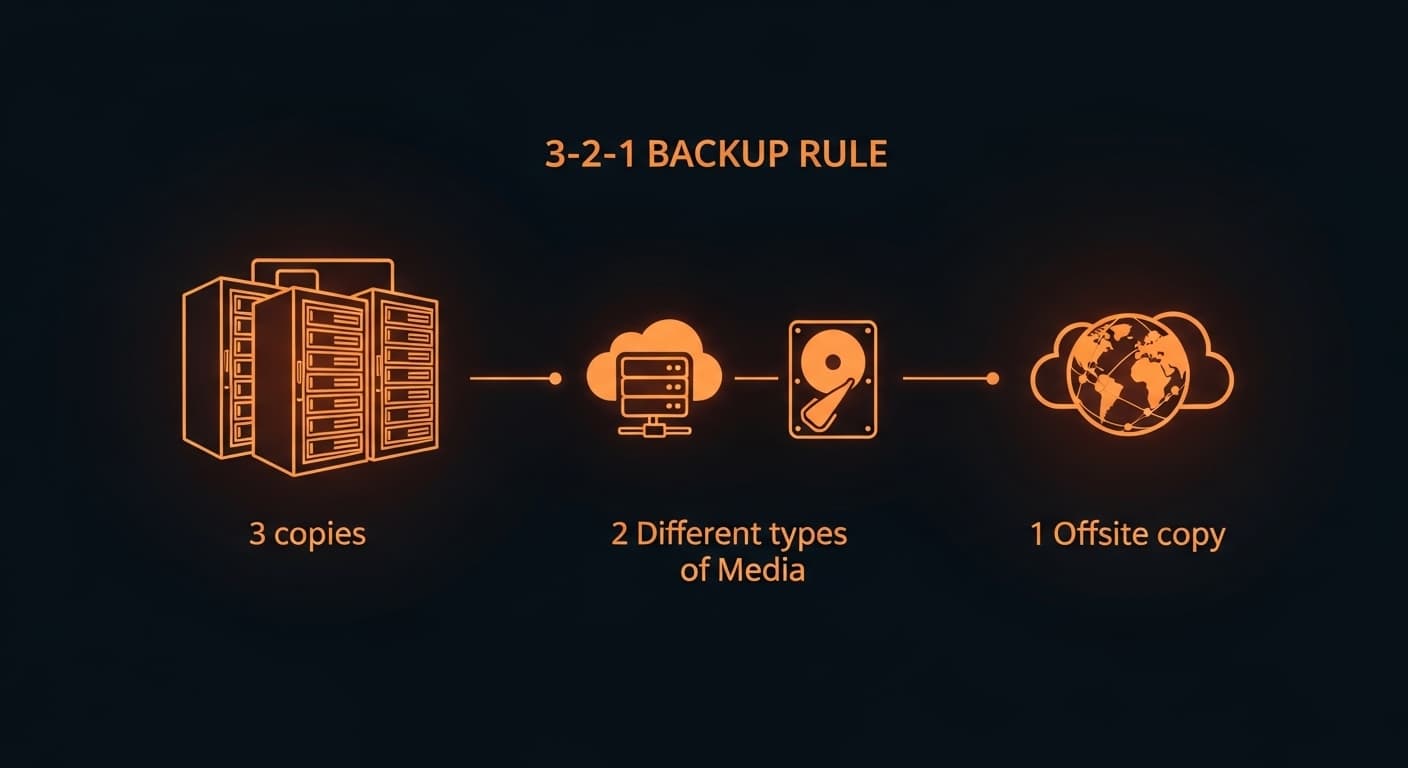
The 3-2-1 rule is a straightforward, highly effective strategy designed to ensure your data is recoverable under almost any circumstances. It provides a structured approach to risk management that mitigates the weaknesses inherent in relying on a single storage medium or location. It is a fundamental principle in data protection, recognised by cybersecurity experts globally.
The rule states:
- 3 copies of your data: You should maintain your primary production data plus two independent backups.
- 2 different media types: Your backups should be stored on at least two distinct types of storage technology. For example, a local disk and cloud storage.
- 1 offsite copy: At least one of these backups must be kept in a physically separate location from your main office.
By adhering to this framework, you systematically remove the "single point of failure" that plagues many businesses. Should your office suffer a fire, theft, or a localised ransomware attack that encrypts your local network, your offsite copy remains untouched and ready for restoration.
Why it matters for UK SMEs
UK SMEs are increasingly becoming primary targets for cyber criminals. The misconception that "we are too small to be targeted" is a dangerous fallacy; attackers often view smaller businesses as "low-hanging fruit" with weaker security perimeters and fewer dedicated IT resources than larger enterprises. Data loss, regardless of its cause, carries significant commercial and reputational risks.
Compliance and the ICO
Under the UK GDPR and the Data Protection Act 2018, you have a clear legal obligation to ensure the integrity and availability of personal data. This includes taking appropriate technical and organisational measures to protect data against accidental loss, destruction, or damage. If your business suffers a data breach—including the permanent loss of personal information due to poor backup practices—the Information Commissioner’s Office (ICO) can issue significant fines. Demonstrating a robust backup strategy is not merely "good IT practice"; it is a foundational component of your regulatory compliance and a key defence against potential penalties.
Cyber Essentials and NCSC Alignment
The UK government’s Cyber Essentials scheme explicitly highlights the importance of backup systems as a core control. By implementing a 3-2-1 strategy, you are moving significantly closer to achieving this certification, which can be a key differentiator when bidding for government contracts or reassuring enterprise-level clients about your security posture. Furthermore, the National Cyber Security Centre (NCSC), the UK's authority on cyber security, consistently recommends comprehensive backup strategies as critical to organisational resilience against cyber threats, particularly ransomware. A well-implemented 3-2-1 rule directly aligns with their guidance for maintaining business continuity.
Business Continuity and Reputation
Beyond compliance, the ability to recover from a data loss event directly impacts your business continuity. Extended downtime due to unrecoverable data can lead to lost revenue, damaged customer relationships, and a significant blow to your reputation. Clients expect their suppliers to safeguard their data. A demonstrated ability to recover swiftly from data loss underscores your reliability and professionalism, helping to maintain trust in your services.
How to implement the 3-2-1 backup rule, a practical walkthrough
Implementing the 3-2-1 rule requires thoughtful planning and the right tools. It is not simply about acquiring more storage; it is about creating a resilient data protection architecture.
1. The Three Copies: Ensuring Redundancy
The first digit of the rule demands three copies of your data. This is often where businesses fall short, mistakenly believing that having their data on their laptop and a synchronised folder in the cloud constitutes two independent copies. However, if you delete a file in your primary folder, the sync service often deletes it from the cloud simultaneously. True "copies" must be independent versions, protected from cascading failures.
- The Live Data: This is your primary working environment. It resides on your servers, workstations, and in your live cloud applications (e.g., Microsoft 365, Google Workspace). This is the data your business uses every day.
- The Local Backup: This serves as a fast, immediate recovery source. It should be an image-based backup of your servers or critical workstations, allowing for "bare metal" restoration if a device fails completely. Local backups are optimised for speed, crucial for minimising Recovery Time Objective (RTO). Network Attached Storage (NAS) devices or dedicated backup appliances are common choices here.
- The Offsite/Cloud Backup: This is your long-term, immutable copy that protects against catastrophic site-wide failure. It is typically stored with a reputable cloud backup provider or in a geographically separate data centre. This copy is designed for disaster recovery, providing resilience against local disasters like fire, flood, or widespread ransomware attacks.
2. Diversifying Your Media: Mitigating Technology Risk
Storing two copies on the same type of hardware or platform introduces a strategic vulnerability. If you have two external hard drives connected to the same server, a power surge or a ransomware strain that targets connected drives can compromise both the original data and the backups simultaneously. Media diversity ensures that a single point of failure in one technology does not lead to total data loss.
- Local Storage (e.g., NAS, dedicated backup appliance): Network Attached Storage (NAS) devices are excellent for localized, rapid recovery. They offer high-speed restoration, which is vital for minimising downtime. They are cost-effective for local storage and can be configured with RAID for internal redundancy.
- Cloud Object Storage (e.g., Azure Blob, AWS S3, dedicated backup cloud): Using an enterprise-grade cloud provider ensures your second medium is disconnected from your local electrical and physical environment. Cloud storage offers scalability, geographical redundancy (within the provider's infrastructure), and often includes features like versioning and immutability.
- Tape (for specific industries and archives): While often seen as "legacy," tape remains a viable, air-gapped medium for long-term archival in highly regulated sectors where permanent, offline storage is required. Its physical disconnection from networks makes it inherently immune to many cyber threats.
By mixing these—for example, a NAS for daily local recovery and a secure cloud bucket for long-term retention—you ensure that a failure in one technology (like a specific controller chip in a hard drive) does not cascade into a total loss.
3. The Critical Importance of the Offsite Copy: Your Ultimate Insurance
The "1" in the 3-2-1 rule is arguably the most important component. It is your ultimate insurance policy. If your business premises are flooded, hit by fire, or suffer a malicious physical attack, any local backup—no matter how sophisticated—will likely be lost.
It is worth noting that many SMEs mistakenly believe that simply using Microsoft 365 or Google Workspace means their data is "backed up." This is a common and dangerous misunderstanding. These services provide high availability (they ensure the service doesn't go down), but they operate on a shared responsibility model. They do not provide comprehensive, point-in-time recovery for human error, malicious deletion, or ransomware. If an employee accidentally deletes a critical folder and it syncs to the cloud, it is gone from the standard M365/Google Workspace recovery points quickly. You need a third-party backup solution that pulls data out of those platforms and stores it in an immutable format elsewhere.
The Role of Immutability
In the modern threat landscape, your offsite copy must be immutable. Immutability means the data is written in a way that it cannot be modified, encrypted, or deleted for a set period, even by an administrator with full access privileges. If a ransomware attacker gains access to your network and tries to wipe your backups, an immutable offsite copy will remain locked and safe, allowing you to restore your business to the state it was in before the attack. This "write once, read many" (WORM) principle is a non-negotiable defence against sophisticated cyber-attacks.
Testing: The Step Most Businesses Ignore
A backup is not a backup until it has been successfully restored. Many businesses pay for backup solutions for years without ever testing if the files are actually usable or if the recovery process works within acceptable timeframes. This oversight can render your entire backup investment worthless when you need it most.
- Regular Restoration Drills: Every quarter, or at least twice a year, pick a random set of files, an application, or a virtual machine and attempt to restore them to a sandbox environment. Document the process and the outcome. This validates both the integrity of your backups and the proficiency of your recovery team.
- Automated Verification: Modern backup software often includes automated integrity checks that verify the health of the backup files and ensure they are restorable. Ensure these are enabled and that you are consistently receiving and reviewing the reports.
- Document Recovery Time Objective (RTO) and Recovery Point Objective (RPO): Understand and document exactly how long it takes to recover your critical systems (RTO) and how much data you can afford to lose (RPO). If it takes three days to restore from the cloud, but your business can only survive four hours of downtime, you need to adjust your strategy to include a faster local restoration method, or invest in more advanced cloud recovery options. From our service desk data, a significant percentage of recovery requests stem from inadequate backup testing or misunderstanding of cloud services. For instance, when we onboarded a 30-user Surrey-based manufacturing firm, their existing 'backup' solution was merely a synchronised cloud drive, completely lacking immutable versions or any offsite separation, and had never been tested. Their RTO was effectively "unknown and likely days."
Common mistakes we see
- Relying solely on cloud synchronisation services: Believing that Microsoft 365, Google Drive, or Dropbox inherently provide comprehensive backups is a dangerous misconception. These are primarily data synchronisation and collaboration tools, not dedicated backup solutions.
- Failing to test backups: An untested backup is merely an expensive hope. Many organisations discover their backups are corrupt or incomplete only when a disaster strikes, at which point it is too late.
- No true offsite copy: Storing all backups locally, even on different devices, leaves a business vulnerable to a single site disaster (fire, flood, theft) or a widespread ransomware attack that encrypts all connected storage.
- Ignoring immutability: Not implementing immutable storage leaves backups vulnerable to deletion or encryption by sophisticated cyber attackers who specifically target backup repositories to prevent recovery.
- Lack of clear RTO/RPO: Without defined Recovery Time Objectives and Recovery Point Objectives, businesses cannot accurately gauge if their backup strategy meets their operational needs, leading to potential significant downtime.
Key Takeaways
To ensure your SME is resilient against the evolving digital threat landscape, keep these core principles at the forefront of your IT strategy:
- Implement 3-2-1: Maintain three copies of your data, on two different media types, with one copy stored offsite.
- Test Regularly: Untested backups are a liability, not an asset. Schedule and execute regular restoration drills.
- Understand Cloud Limitations: Cloud file-syncing is a convenience, not a comprehensive backup solution.
- Prioritise Immutability: Utilise immutable storage to prevent ransomware from compromising your backups.
- Meet Compliance: Robust backups are fundamental to UK GDPR compliance and Cyber Essentials readiness.
Data loss is not a matter of "if," but "when." Whether through a simple human error, a hardware failure, or a sophisticated cyber-attack, your business will eventually face a moment where its data is at risk. By implementing the 3-2-1 backup rule today, you are not just buying insurance; you are buying the peace of mind that comes with knowing your business can withstand almost any storm, which, in fairness, is a rather good investment.
When to call in help
Implementing a truly resilient 3-2-1 backup strategy, particularly one that incorporates immutable cloud storage and regular testing protocols, can be complex. It requires specialist knowledge of various technologies, an understanding of RTO/RPO objectives, and ongoing management to ensure compliance and effectiveness. If your internal resources are stretched, or if you lack the specific expertise to design, implement, and maintain a robust backup architecture, it is pragmatic to seek external assistance.
To take the next step