
For many UK small-to-medium enterprises (SMEs), the question of how to manage IT infrastructure is a pivotal strategic decision. As your business scales, the complexity of your technology stack increases, making the choice between hiring an in-house IT professional and partnering with a Managed Service Provider (MSP) more than just a matter of convenience. It is a fundamental financial and operational commitment that directly impacts your efficiency, security, and growth potential. While an in-house employee offers proximity and singular focus, a professional MSP provides a broad, resilient support structure that is often more cost-effective and secure. In an era where UK businesses face constant cyber threats and stringent regulatory requirements under the UK GDPR, choosing the wrong model can lead to significant downtime, data breaches, and bloated overheads. This guide explores the true cost of both approaches to help you make an informed decision for your company’s future.
What "In-house IT" and "Outsourced MSP" Actually Mean
To begin, it is important to clarify what each model entails for a UK SME.
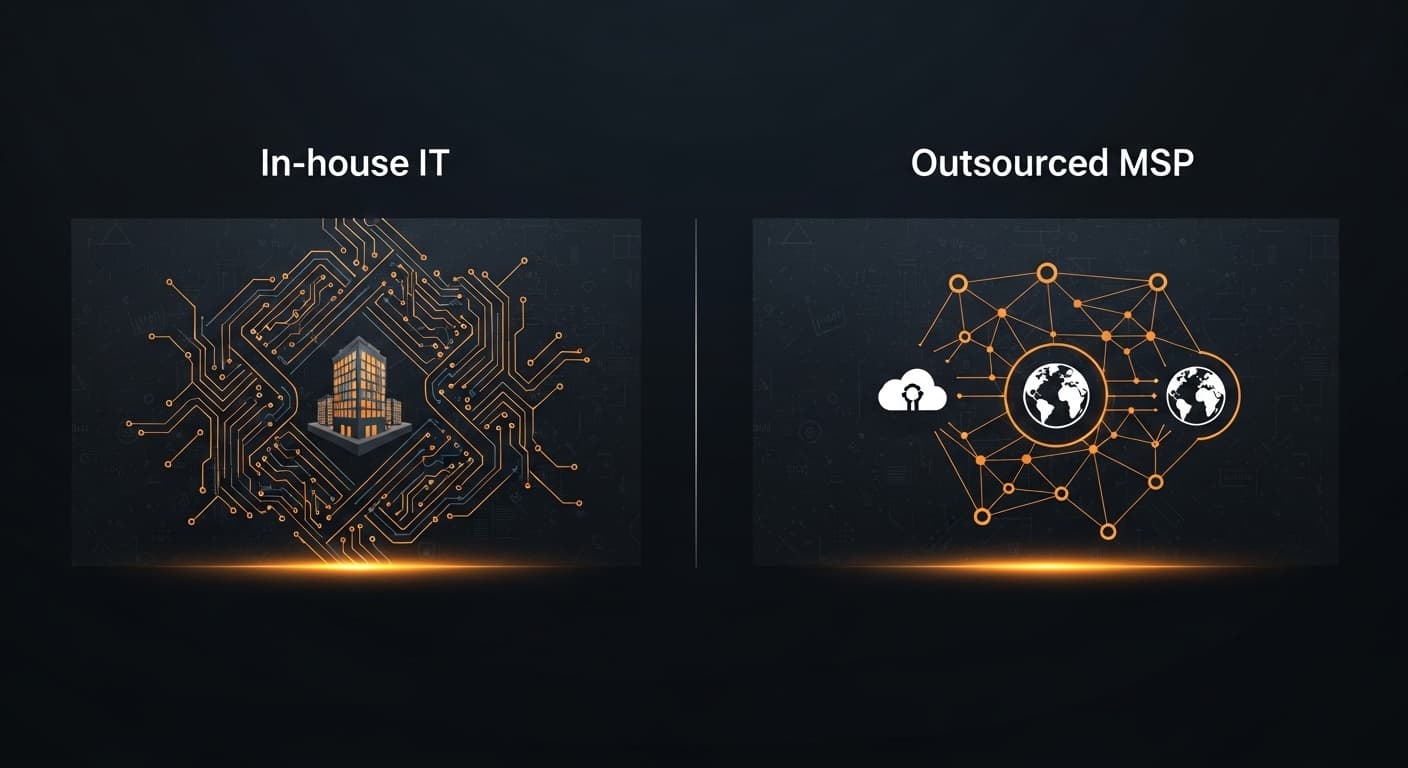
In-house IT refers to employing one or more individuals directly to manage all your technology needs. This person, or small team, is a full-time employee, receiving a salary, benefits, and working exclusively for your company. Their responsibilities typically range from basic helpdesk support and hardware maintenance to network administration and some strategic planning, all within the confines of their individual skillset and capacity.
An Outsourced Managed Service Provider (MSP), by contrast, is an external company that takes on responsibility for your IT infrastructure and support. You engage them through a service contract, usually on a predictable monthly fee. An MSP provides a team of specialists, not just one person, covering areas such as helpdesk support, network management, cloud services, cybersecurity, and strategic IT consultancy. They act as an extension of your business, providing proactive monitoring and management, often remotely.
Why it Matters for UK SMEs
The choice between these two models is more than an operational preference; it has significant commercial and regulatory implications for any UK SME. Ignoring these aspects can result in tangible financial penalties and long-term damage to your business.
Firstly, cybersecurity is no longer optional; it is a business imperative. UK SMEs are increasingly targeted by sophisticated cyber threats. The National Cyber Security Centre (NCSC) regularly highlights the growing risks of ransomware, phishing, and data breaches. A robust defence is critical, not just for protecting your assets but for maintaining customer trust. Without adequate protection, the financial and reputational fallout from an incident can be substantial.
Secondly, regulatory compliance carries serious weight. The Information Commissioner’s Office (ICO) enforces the UK GDPR, imposing significant fines for organisations that fail to adequately protect personal data. Demonstrating due diligence in IT security and data management is not merely good practice; it is a legal requirement. Businesses are expected to have appropriate technical and organisational measures in place. Compliance with frameworks like Cyber Essentials, a UK government-backed scheme, provides a recognised baseline for security and often a prerequisite for certain contracts.
Finally, consider operational resilience and strategic growth. Downtime, whether from IT failures or security incidents, directly impacts productivity and profitability. Every hour your staff cannot work, or your systems are offline, represents lost revenue and increased frustration. Furthermore, as your SME grows, your IT needs become more complex. Your technology should enable, not hinder, expansion. A well-considered IT strategy can provide a competitive edge, allowing you to adapt to market changes and leverage new technologies efficiently. Getting this decision wrong can stifle innovation and create unnecessary overheads.
How to Evaluate Your Options: A Practical Comparison
Making an informed decision requires a clear-eyed look at the practicalities and true costs of each model across several key areas.
Cost: Beyond the Salary
When you consider an in-house IT professional, it is easy to focus solely on the gross salary. However, the "Total Cost of Employment" (TCE) in the UK extends significantly further.
- In-house IT: Beyond the basic wage, you must factor in employer National Insurance Contributions (NICs), statutory pension contributions, and often private medical insurance or other benefits. Recruitment itself is a cost, involving agency fees, advertising, and valuable management time spent on interviewing and onboarding. Crucially, an in-house IT individual requires their own tools: licences for monitoring software, backup solutions, endpoint security, and often a budget for hardware and infrastructure. These can easily run into thousands of pounds annually, in addition to their salary.
- Outsourced MSP: This model typically operates on a predictable, fixed monthly fee. This fee covers a comprehensive suite of services, including helpdesk support, proactive monitoring, patch management, cybersecurity tools, backup solutions, and often strategic IT advice. You move from an unpredictable Capital Expenditure (CapEx) model (buying expensive software and hardware upfront) to a manageable Operational Expenditure (OpEx), which is far easier to budget for. The MSP absorbs the cost of enterprise-grade tools, passing on the benefits of economies of scale.
Expertise: Generalist vs. Specialist Team
The breadth and depth of technical expertise available are critical differentiators.
- In-house IT: A single IT professional, no matter how capable, is a generalist by necessity. They might be proficient in several areas, but it is unrealistic to expect them to be an expert in everything from networking infrastructure, cloud architecture (Azure, AWS), advanced cybersecurity threat hunting, data privacy regulations, and specific business application support. When they encounter an issue outside their core competency, you face a choice: either pay for expensive external contractors, creating a "double-spend" scenario, or risk a slower, less effective resolution. Furthermore, a single person represents a "single point of failure." When they are on holiday, ill, or leave the company, your technical support capacity comes to a standstill, often at the worst possible moment.
- Outsourced MSP: An MSP provides access to a diverse team of specialists. You gain expertise across multiple disciplines: network engineers, cloud architects, cybersecurity analysts, helpdesk technicians, and virtual CIOs (vCIOs). This collective knowledge means complex issues are resolved more efficiently, and strategic advice is grounded in broad industry experience. The team structure also eliminates the single point of failure; there is always someone available to address your needs. We onboarded a 40-user London accountancy firm last quarter and the first thing we addressed was their lack of centralised patch management, which their previous sole IT individual simply didn't have the tools or time to implement effectively. Expecting one individual to be a master of all these domains is, frankly, a triumph of optimism over reality.
Security & Compliance: Reactive vs. Proactive Defence
In the current threat landscape, a reactive approach to security is simply insufficient.
- In-house IT: A lone IT individual is often overwhelmed by day-to-day firefighting (password resets, printer issues). Security tasks, such as regular patching, vulnerability assessments, and threat monitoring, frequently fall by the wayside due to time constraints and a lack of specialised tools. While they may install antivirus, they often lack the sophisticated Endpoint Detection and Response (EDR) or Security Information and Event Management (SIEM) systems necessary for proactive threat hunting and rapid incident response. This leaves your business exposed to evolving cyber threats and potentially non-compliant with UK GDPR. On a recent client tenant audit for a 60-user engineering firm in the Midlands, we found their sole in-house IT manager had no dedicated budget for endpoint detection and response, leaving them reliant on basic antivirus.
- Outsourced MSP: Security is a cornerstone of an MSP's service. Reputable MSPs invest heavily in enterprise-grade security tools, often including advanced firewalls, EDR, email filtering, and regular vulnerability scanning. They employ dedicated cybersecurity professionals who proactively monitor your systems for threats, implement patches, and respond to incidents around the clock. An MSP will also work to ensure your business adheres to UK government-backed standards like Cyber Essentials, providing a recognised baseline for security and assisting with UK GDPR compliance. The cost of a single data breach, including ICO fines, legal fees, business interruption, and reputational damage, vastly outweighs the annual cost of a managed service contract.
Scalability & Business Continuity: Static vs. Agile Support
Your IT should flex with your business needs, not hinder them.
- In-house IT: Scaling an in-house IT team is a slow and expensive process. Adding new staff means more recruitment, onboarding, training, and increased salaries and benefits. If your business experiences rapid growth or seasonal fluctuations, your IT capacity can quickly become a bottleneck. Furthermore, disaster recovery and business continuity planning often become secondary concerns for a single IT person, who may lack the resources or expertise to implement robust solutions.
- Outsourced MSP: An MSP is inherently scalable. Whether you are adding five new users, opening a second office, or migrating to a new cloud platform, an MSP can instantly adjust resources without you needing to hire and train new staff. Their infrastructure is designed to support growth. Crucially, MSPs provide robust disaster recovery and business continuity solutions, often built into their service. This ensures that your business can recover from a server failure, data loss, or other significant incidents in hours, not days, minimising downtime and protecting your bottom line.
Common Mistakes We See
In our experience, UK SMEs often make several recurring errors when considering their IT management strategy:
- Underestimating the true cost of employment: Many only factor in salary, completely overlooking NICs, pensions, benefits, recruitment, and the ongoing training necessary for an in-house role.
- Assuming one person can cover all IT disciplines: Technology is too broad and complex for a single individual to be an expert in everything from networking to advanced cybersecurity.
- Neglecting the cost of downtime and lost productivity: The hidden financial drain of staff troubleshooting their own IT issues or waiting for support is often substantial.
- Prioritising upfront cost over long-term value and security: Choosing the cheapest option, whether in-house or an MSP, without assessing the depth of service and security provisions can lead to greater costs down the line.
- Failing to plan for staff absence or departure: A single in-house IT resource creates a critical vulnerability if they are unavailable or leave the company unexpectedly.
Key Takeaways
To summarise the cost-benefit analysis for your SME:
- Employment costs are deceptive: Always factor in NICs, pensions, recruitment, training, software licences, and the cost of covering staff absence beyond just the base salary.
- MSPs provide depth and resilience: You gain access to a team of experts across multiple disciplines (cybersecurity, cloud, networking) for a predictable monthly fee, eliminating single points of failure.
- Compliance is a business imperative: Reputable MSPs ensure you meet UK GDPR and Cyber Essentials standards, significantly mitigating the risk of substantial ICO fines and reputational damage.
- Productivity is currency: Outsourcing reduces downtime and allows your staff to focus on their core roles, rather than troubleshooting IT issues, directly impacting your bottom line.
- Scalability is built-in: An MSP's services scale instantly with your business growth, providing flexibility without the overheads of hiring and training new internal staff.
Ultimately, the choice between in-house IT and an MSP should be driven by your long-term business goals, appetite for risk, and a realistic assessment of your budget. If your priority is growth, comprehensive security, predictable costs, and operational efficiency, partnering with a dedicated support provider allows you to stop worrying about your infrastructure and start focusing on your customers.
To take the next step