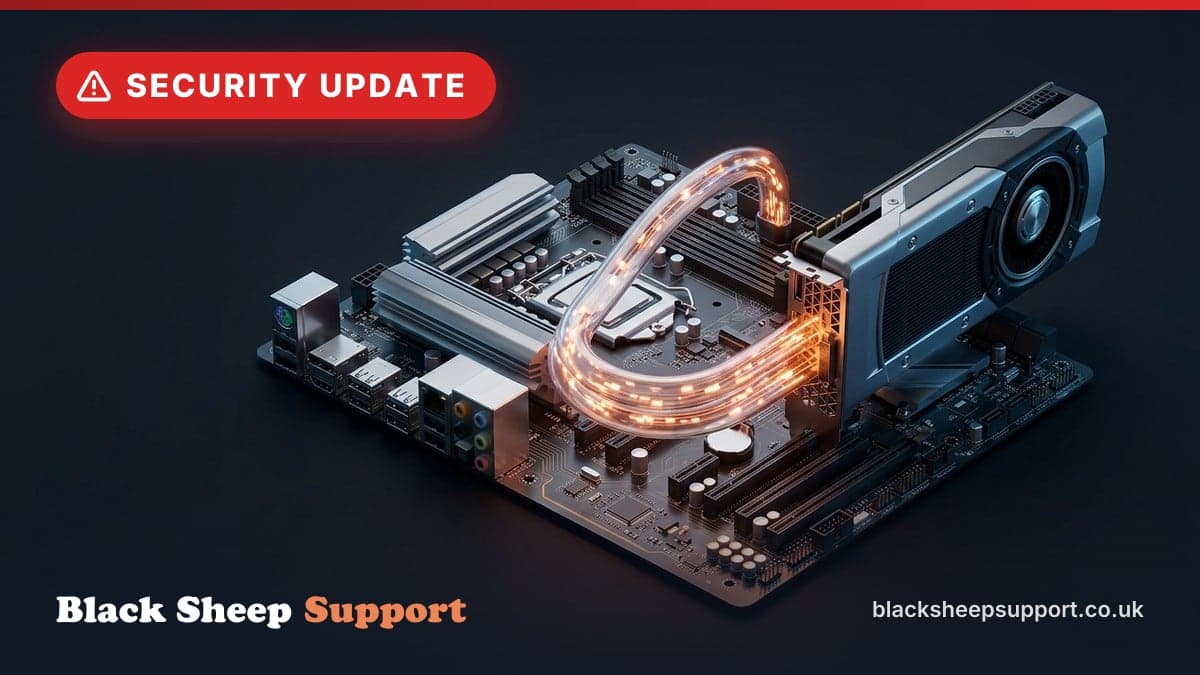
Criminals are now exploiting Graphics Processing Units (GPUs), the specialised processors that handle visual output in almost every modern computer. For years, security efforts focused on Central Processing Units (CPUs), main memory (RAM), and network traffic. GPUs, once used mainly by gamers and video editors, now power everything from web browsing to artificial intelligence (AI). This widespread use means they are a target. GPUBreach attacks exploit GPU memory, a new threat UK businesses need to understand.
What GPUBreach actually means
A Graphics Processing Unit, or GPU, is a specialised processor within your computer. Its primary role is to rapidly handle tasks related to visual output, essentially creating the images you see on your screen. To perform this, it uses its own dedicated, high-speed memory, known as Video RAM (VRAM). Traditionally, security efforts have concentrated on protecting the Central Processing Unit (CPU) and its main memory (RAM). A GPUBreach attack bypasses these conventional defences. Instead of targeting the CPU, attackers find ways to access the GPU’s VRAM, which temporarily holds sensitive visual data. Imagine your computer displaying a confidential invoice; a GPUBreach attack could capture that data directly from the VRAM, even if it’s only there for milliseconds. This allows attackers to potentially intercept passwords, financial details, or personal data as they appear on screen.
Why it matters for UK SMEs
GPUBreach attacks are a direct threat to UK SMEs, with commercial and legal consequences.
Firstly, a GPUBreach attack that exfiltrates customer or employee personal data is a data breach under the General Data Protection Regulation (GDPR). The Information Commissioner's Office (ICO) holds organisations accountable for protecting personal data, regardless of the technical method of compromise. Non-compliance can result in fines and reputational damage. Losing customer trust is difficult to recover from.
Beyond GDPR, the commercial impact is broad. For businesses in design, engineering, or any field using complex visualisations, intellectual property theft is a risk. GPU memory often holds proprietary models or sensitive designs, which, if compromised, could be valuable to competitors. Attackers could also harvest login credentials for banking, cloud services, or internal systems. This could lead to financial loss, service disruption, and extensive recovery costs.
It is easy to assume such sophisticated attacks are beyond the remit of an SME. However, the National Cyber Security Centre (NCSC) consistently advises that cybercriminals adapt and commoditise advanced techniques. These GPU-based exploits will inevitably be integrated into readily available hacking tools, making them accessible to a broader range of attackers targeting businesses of all sizes, including yours.
The widespread use of GPU acceleration in everyday software amplifies this risk. Your operating system, office applications, video conferencing tools, and web browsers, all leverage the GPU. This means the attack surface is present on virtually every device your employees use daily. A malicious script, perhaps embedded in an advertisement or a compromised website, could be running in one browser tab, attempting to 'spy' on sensitive data being displayed in another.
From a compliance perspective, adhering to schemes like Cyber Essentials is important. While GPUBreach may not be explicitly listed, its foundational principles directly address the initial attack vectors. Secure configuration, patch management, malware protection, and access control are all critical in preventing the initial compromise that could lead to a GPUBreach. Demonstrating these controls to the ICO following any incident would be essential, showing you took reasonable steps to protect data. Many SMEs are not yet consistently applying these fundamentals, leaving them unnecessarily exposed.
Practical Steps to Mitigate the GPUBreach Threat
While the GPUBreach threat is technically sophisticated, the practical defences use established security best practices. You do not need a PhD in computer science to protect your business; you need a disciplined, multi-layered approach to IT security, consistently applied.
1. Keep Everything Updated
This remains the most critical preventative measure. Hardware manufacturers, including NVIDIA, AMD, and Intel, are actively addressing potential vulnerabilities in their Graphics Processing Units. They release regular updates for their GPU drivers that often contain security patches. Ignoring these updates leaves a known vulnerability open.
- GPU Drivers: Establish a process for regularly updating graphics drivers across all company devices. Relying solely on standard Windows Update or macOS updates is insufficient; these often lag behind the latest releases from hardware manufacturers. Centralised management tools are typically required for this.
- Operating Systems: Ensure Windows, macOS, and any other operating systems are kept fully patched with the latest security updates. This closes common entry points for malware that might then attempt a GPU-based attack.
- Web Browsers: As a primary attack vector, browsers must be configured for automatic updates. Ensure employees understand they should not disable this feature.
- Experience Signal: Onboarding a 40-user London accountancy firm last quarter highlighted this issue. The first thing we addressed was their complete lack of centralised GPU driver management. We found over 70% of their devices were running drivers that were more than 18 months out of date, creating an unnecessary exposure to known vulnerabilities.
2. Fortify Your Web Browsing Environment
Given that the web browser is a highly probable entry point for GPUBreach attacks, strengthening its security is important.
- Implement a Reputable Ad-Blocker: Many GPUBreach attacks can be delivered via malicious advertisements, known as 'malvertising'. An ad-blocker, such as uBlock Origin, can prevent these scripts from executing, neutralising a common attack.
To take the next step and protect your business
Want this handled for you? See Cyber security services.
Based in Brighton or Hove? We are too: see IT support in Brighton.
Free, no sales call needed
Two free checks. Know where you stand.
Domain email check
Can someone send email pretending to be you? Is your real email landing in junk? Type your domain and find out in under a minute.
IT Health Check
A short set of questions that scores your security and business risk, and tells you what to fix first. 15 to 20 minutes on your own.