
For UK Small and Medium-sized Enterprises (SMEs), winning a government contract can be a significant moment, offering stability, enhanced credibility, and a platform for growth. Public sector procurement is competitive and rigorous, however. In an environment where trust and security are paramount, your business needs to demonstrate it's a safe pair of hands for public data and services. The answer, increasingly, is a government-backed certification: Cyber Essentials. This is not merely administrative paperwork; it is a foundational requirement and a powerful differentiator that signals your commitment to cyber security, often acting as the key to lucrative government tenders. This guide explains precisely what Cyber Essentials is, why it is critical for public sector bids, and the practical steps you need to take to achieve it.
What Cyber Essentials actually means
Cyber Essentials is a UK government-backed scheme designed to help organisations of any size protect themselves against a wide range of common cyber attacks. It acts as a baseline of essential security hygiene, providing a clear statement of the fundamental controls all organisations should have in place to mitigate risk from internet-based threats. The scheme is specifically tailored to be achievable for SMEs, recognising that not every business has a dedicated security team. Its focus is on five key technical controls which, when implemented correctly, can defend against approximately 80% of prevalent cyber attacks. It's about establishing a solid defence, not an impenetrable fortress.
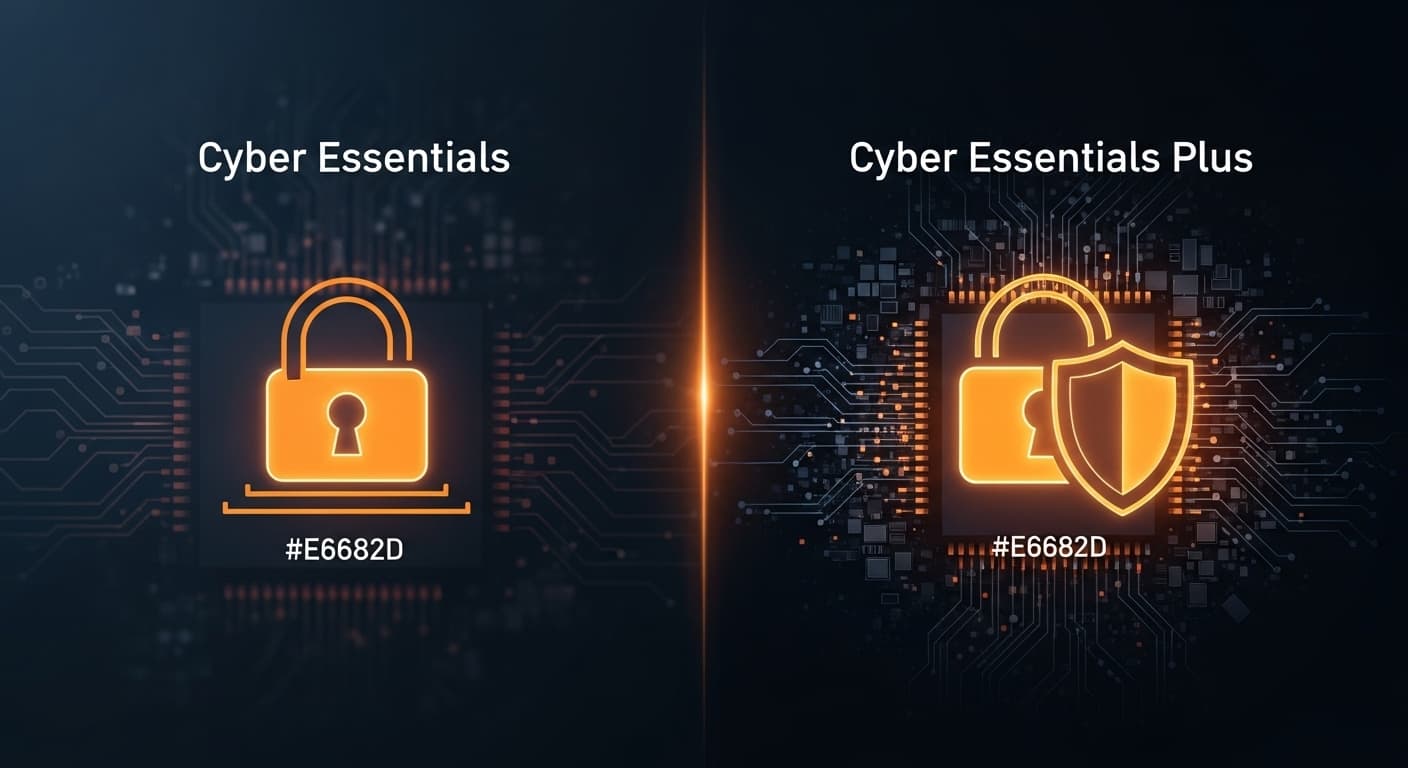
Cyber Essentials (CE)
This is the foundational level. It involves a self-assessment process where your organisation completes an online questionnaire (the SAQ) detailing its security practices across the five controls. A Certification Body then reviews and verifies this questionnaire. Upon successful assessment, you receive certification and are permitted to display the Cyber Essentials badge. It offers a cost-effective way to demonstrate essential security measures.
Cyber Essentials Plus (CE Plus)
Cyber Essentials Plus builds upon the basic level. It includes all the requirements of CE, but with a crucial addition: your cyber security measures are independently tested and verified by a qualified auditor. This hands-on technical audit involves vulnerability scans and system tests to confirm that the five controls are not just declared to be in place, but are functioning effectively in practice. For government contracts handling more sensitive data or involving higher risk, CE Plus is often the expected standard, providing a much higher level of assurance to the contracting authority.
Why it matters for UK SMEs
For many government contracts, particularly those with central government departments, Cyber Essentials is not a 'nice-to-have', it is a mandatory, non-negotiable requirement. The UK Government correctly identified its own supply chain as a potential weak link in national security. A breach at even a small supplier could, theoretically, compromise a major government department or sensitive data.
Consequently, numerous central government contracts, especially those involving the Ministry of Defence (MoD) or the handling of personal and sensitive information, explicitly state that bidders must hold a valid Cyber Essentials certificate at the time of application. Consider it a necessary entry pass; without it, your business simply cannot participate in the bidding process. Procurement managers utilise it as an initial filter; a tender submission without the requisite certification may be disqualified before its merits are even considered.
This requirement is typically outlined in tender documentation, often within sections labelled "Information Assurance," "Security Requirements," or "Supplier Standards." The specific level required (basic or Plus) will also be stipulated. By establishing Cyber Essentials as a prerequisite, the government ensures that every organisation within its supply chain possesses, at a minimum, a fundamental understanding of cyber security and has taken verifiable steps to protect their systems. The National Cyber Security Centre (NCSC) actively promotes the scheme as a baseline for good practice, reinforcing its importance across the public sector.
Beyond the mandate, holding Cyber Essentials certification provides a significant competitive advantage. In a crowded field of bidders, it offers a clear and verifiable method to differentiate your business and establish immediate trust.
Demonstrating Due Diligence and Trust
Procurement managers are inherently risk-averse. Their role involves selecting partners capable of delivering services reliably and securely. A Cyber Essentials certificate serves as independent, government-endorsed validation of your security posture. It communicates several key messages to the contracting authority:
- Your business takes cyber security seriously.
- You have invested time and resources into protecting your data and systems.
- You represent a lower-risk partner compared to a competitor lacking such certification.
- You are aligned with government and NCSC best practices for cyber hygiene.
This straightforward badge of assurance can be the deciding factor between two otherwise comparable proposals. It replaces uncertainty with documented proof of your competence. Furthermore, for those handling personal data, Cyber Essentials provides a clear framework for meeting the "appropriate technical and organisational measures" required under the General Data Protection Regulation (GDPR). The Information Commissioner's Office (ICO) views such certifications favourably as evidence of due diligence in data protection.
Streamlining the Procurement Process
Tender applications are often extensive, featuring complex questionnaires covering everything from financial stability to environmental policies. The security section, in particular, can be daunting, filled with technical questions challenging to answer without a clear framework.
Holding Cyber Essentials certification simplifies this entire section. You can refer to your certificate as evidence that you meet a recognised, government-backed standard. This not only saves you considerable time in completing the bid but also provides the procurement team with a straightforward 'tick-box' method to approve your security credentials, reducing the need for protracted follow-up questions and clarifications. It signals maturity and a proactive approach to risk management, which is always well-received by public sector buyers.
How to achieve Cyber Essentials: A practical walkthrough
Achieving Cyber Essentials is a manageable process, particularly with appropriate guidance. Here is a typical roadmap for a UK SME, detailing the five technical controls and the steps to certification.
The Five Technical Controls
At the core of Cyber Essentials are five technical controls. They are practical, address common vulnerabilities, and form the backbone of your defence.
-
Boundary Firewalls and Internet Gateways: Your firewall acts as a digital gatekeeper, monitoring and controlling network traffic based on defined rules. It establishes a crucial barrier between your internal network and the internet. For most SMEs, this involves configuring the firewall provided with your office internet router, ensuring default administrative passwords are changed, and closing any unnecessary ports. Cloud firewalls for services like Microsoft 365 or Azure also fall under this control.
-
Secure Configuration: Devices often ship with default settings optimised for convenience, not security. Secure configuration means hardening these devices from the outset. This includes changing all default passwords, removing or disabling unused software and services that could be exploited, and configuring systems to minimise their 'attack surface'. Think of it as stripping down a new device to only what's absolutely essential, then building security around that.
-
Access Control: This control is rooted in the "principle of least privilege." Staff should only have access to the software, settings, and data strictly necessary for their job roles. User accounts with elevated administrative privileges must be tightly controlled and used only when essential for specific tasks. This prevents a compromised standard user account from being exploited to cause widespread damage across your network. Multi-Factor Authentication (MFA) is also critical here, adding a layer of verification beyond just a password.
-
Malware Protection: Malware, encompassing viruses, ransomware, and spyware, remains a primary threat. This control requires robust protection using either actively updated anti-malware software on all devices, or 'application allowlisting', which prevents any unauthorised software from running. For most SMEs, a reputable, business-grade anti-malware solution, centrally managed and regularly updated, is the most practical and effective approach.
-
Patch Management (or Security Update Management): Software developers continuously release updates (patches) to fix newly discovered security vulnerabilities. Cyber criminals actively target systems running outdated, unpatched software. Patch management is the systematic process of ensuring all your operating systems and applications are kept up to date. This means applying security patches promptly, ideally within 14 days of release, for all critical and high-risk vulnerabilities. Automated patching systems are often the most reliable method.
The Certification Roadmap
The journey to Cyber Essentials certification follows a structured path:
-
Scoping and Gap Analysis: Define the precise 'scope' of your assessment. This includes all in-scope devices (computers, servers, mobile devices), software, and cloud services that connect to the internet and handle business data. Once the scope is clear, conduct a gap analysis. This is a review of your current setup against the five technical controls to identify any shortcomings. An experienced IT partner can be invaluable here, offering an expert eye to spot weaknesses you might overlook. On a recent client tenant audit for a 60-user Surrey-based logistics firm, we found that nearly a third of their users had not enabled MFA, a critical gap for Cyber Essentials compliance. This kind of detail is easy to miss without a structured review.
-
Remediation: This is the practical implementation phase. Based on your gap analysis, you will need to make the necessary changes to meet the requirements. This often involves:
- Updating firewall rules and router configurations.
- Enforcing strong password policies and deploying MFA.
- Uninstalling legacy or unnecessary software.
- Implementing or upgrading a robust anti-malware solution.
- Establishing a formal, automated process for applying software updates.
- Reviewing user permissions and removing any unnecessary administrative access.
-
The Self-Assessment Questionnaire (SAQ): Once all remediation work is complete and you are confident your systems meet the requirements, you complete the SAQ for basic Cyber Essentials certification. This detailed questionnaire requires you to formally declare how you meet each requirement. Accuracy and truthfulness are paramount, as this declaration underpins your certification.
-
External Audit (for Cyber Essentials Plus): If you are aiming for CE Plus, a certified auditor will then conduct a series of technical tests. This includes external vulnerability scans of your internet-facing systems and on-device tests to verify, for example, that your malware protection is active and your software is correctly patched. Passing this independent audit validates your self-assessment and awards you the higher-level certificate.
Common mistakes we see
Even with clear guidance, certain pitfalls are common during the Cyber Essentials certification process:
- Incorrect Scoping: Businesses often overlook mobile devices, home-worker laptops, or specific cloud services that fall within the scope, leading to failed assessments.
- Neglecting Legacy Systems: Old servers or applications, particularly those no longer receiving security updates, pose a significant risk and are often overlooked in patching strategies.
- Weak Access Control: Failing to implement Multi-Factor Authentication (MFA) or allowing excessive administrative privileges for standard users is a frequent issue.
- Inadequate Patch Management: Relying on manual updates or failing to apply critical patches within the stipulated 14-day window is a common cause for non-compliance.
- Assuming Basic Anti-Virus is Enough: Consumer-grade anti-virus software often lacks the centralised management and advanced features required for a business environment.
- Poor Documentation: Not having clear policies or evidence of implemented controls can complicate the verification process, even if the controls are technically in place.
Key Takeaways
- A Gateway to Government Work: Cyber Essentials certification is often a mandatory requirement for UK central government contracts, acting as a filter for potential suppliers.
- A Powerful Competitive Edge: Even when not mandatory, the certification builds trust and demonstrates a professional, low-risk approach to security, setting you apart from the competition.
- Based on Five Core Controls: The scheme is built on five practical technical controls: firewalls, secure configuration, access control, malware protection, and patch management.
- Demonstrates Due Diligence: It provides verifiable proof to procurement teams, clients, and regulators like the ICO that you are serious about cyber security and data protection.
- Strengthens Your Entire Business: The benefits extend beyond a single contract, improving your overall security posture, aiding GDPR compliance, and opening doors in the private sector.
When to call in help
While Cyber Essentials is designed to be accessible, the process of scoping, gap analysis, remediation, and particularly the CE Plus audit can be time-consuming and technically demanding for SMEs without dedicated IT security staff. Engaging an experienced IT and cyber security provider can streamline the entire process, ensuring compliance is met efficiently and effectively, allowing you to focus on running your business. Frankly, trying to do it all yourself often ends up costing more in time and rework than simply getting it right the first time.
To take the next step, [book a Discovery Call with our expert engineers today](https://ithealthcheck.blacksheepsupport.
To take the next step and protect your business